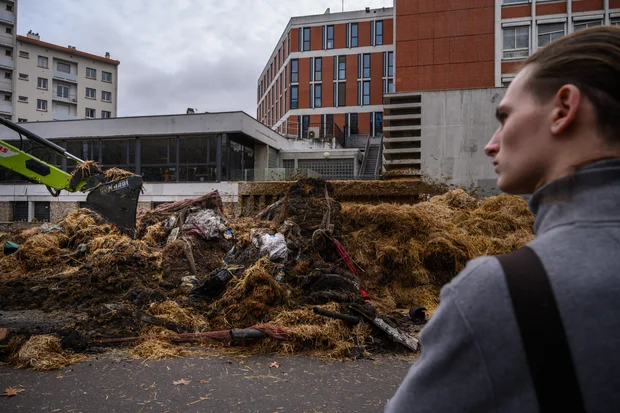
In December 2025, a powerful and symbolic protest unfold in France that drew worldwide attention. A group of French farmers dumped huge quantities of manure, tires, cabbages, garbage and even placed a coffin outside President Emmanuel Macron’s holiday home in Le Touquet on the northern coast.

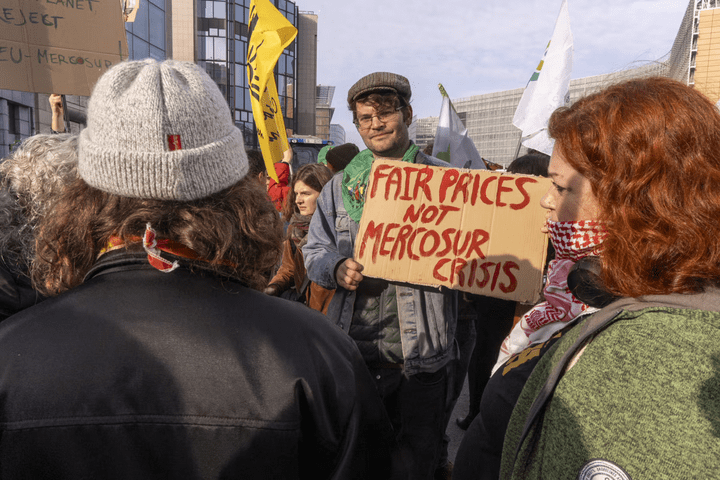
Their message was clear and striking: they oppose a controversial trade deal between the European Union and the South American Mercosur bloc that they see as a threat to French agriculture.
While this dramatic gesture made headlines, it was just one part of a broader moment of rural discontent that has been building across the country.
What Happened in Le Touquet and Across France?
On Friday, December 19, 2025, dozens of farmers gathered outside President Macron’s seaside holiday residence in Le Touquet, a popular holiday town in northern France.
They unloaded tons of animal manure and other farm waste on the streets, laid tyres and cabbages around the area, and placed a coffin with slogans such as “No to Mercosur” and “RIP Agri” to symbolize what they see as the death of French farming if the Mercosur trade deal goes through. They did this under heavy police surveillance, and the protest was peaceful but highly symbolic.
The protest in Le Touquet was part of a larger wave of demonstrations that have involved farmers blocking highways with tractors and straw bales, dumping manure on major roads, and holding rallies in rural towns from the south to the north of France.
As of late December, these protests had been ongoing for more than a week.
Why Farmers Say They are So Angry?

When I talk to farmers and read their statements, their anger is not about one single issue. It is about a combination of serious problems that they feel threaten their livelihoods.
1. A Trade Deal They See as Harmful
The most immediate concern for these farmers is the proposed European Union‑Mercosur trade agreement. This pact, negotiated over more than two decades, would cut tariffs and open EU markets to millions of tones of agricultural goods, including meat, soybeans, poultry and sugar, from South American countries like Brazil and Argentina.
While supporters say the deal will help diversify markets and promote exports, many farmers in France and other EU countries worry that cheaper imports will flood the market and undercut their products.
French farmers specifically fear that imported products will be made under different environmental and health standards, or “lower standards,” compared with EU rules, creating unfair competition and pushing down prices for local produce.
That fear fuels their demand that the Mercosur agreement be blocked or significantly revised before it is ratified.
2. Lumpy Skin Disease and Herd Culling Policies
Alongside trade fears, the protests are also deeply tied to how the French government is handling a new outbreak of lumpy skin disease, a viral infection that affects cattle herds.
Under current disease control policies, entire herds are being culled if even a single animal tests positive in order to prevent the virus from spreading. Many farmers feel this approach is too harsh and destructive, particularly when it results in the loss of whole herds and economic ruin for small and mid‑sized livestock producers.
Some agricultural unions and protesters argue that vaccination and other containment strategies should be prioritised over mass culling, and they point to successful disease responses in other European countries as evidence that alternatives exist.
In response, the French government has even drafted in army veterinarians and additional vaccine doses to expand a nationwide vaccination campaign aimed at 750,000 cattle, showing the scale of the lumpy skin threat and official effort to control it.
3. Broader Economic Pressures
The protests also reflect longer‑standing frustrations over economic pressures on farmers. High production costs for fuel, fertiliser, machinery and labour, combined with competition from imported food goods and unpredictable weather linked to climate change, have put pressure on farm incomes.
Many farmers feel squeezed and believe that both national and EU policies favor cheaper imports and large agribusiness over family farms.
How the Protests Unfolded?
Around the same time as the Le Touquet demonstration, farmers have carried out a variety of protest actions across France:
- Blocking Highways: Farmers have used tractors and straw bales to block sections of major motorways, slowing holiday traffic and drawing attention to their cause in regions like the southwest.
- Dumping Manure and Produce: In towns such as Avignon, protesters threw potatoes and dumped manure in public squares and in front of administrative buildings as acts of defiance.
- Symbolic Displays: Farmers placed coffins next to slogans outside presidential residences and local government offices to highlight their belief that agriculture is being “killed” by unfair policies.
The protests have drawn participants from local agricultural unions such as Coordination Rurale and Confédération Paysanne, and some smaller grassroots farmer groups.
While some unions have agreed in principle to temporary pauses for holiday periods, others have left it up to local chapters to decide whether actions continue.
Government Response
The French government has been trying to balance public order with listening to farmers’ concerns. Officials have publicly appealed for a Christmas truce, warning that blockades and disruptions during the holiday season are not acceptable, and that authorities will act to prevent further blockades if necessary.
Prime Minister Sébastien Lecornu held negotiations with major agricultural union leaders, and government spokespeople reiterated that written responses to farm demands would be key in determining whether protests pause.
At the same time, authorities have taken steps to address at least part of the farmers’ immediate concern about lumpy skin disease, bringing in military support and large vaccine supplies to manage outbreaks more effectively.
President Macron also said he would not endorse the Mercosur trade deal unless protections for European farmers were strengthened to prevent economic harm.
Some farmer groups, such as the Young Farmers union, indicated they would observe a holiday truce, while others said they needed clearer policy changes before suspending protests.
The Mercosur Trade Agreement: Why It Matters
To understand the intensity of the protests, it helps to know a bit about the Mercosur trade agreement.
The EU‑Mercosur Association Agreement aims to create one of the world’s largest free trade areas, linking economies with a combined population of about 780 million people. It would eliminate the majority of tariffs between the EU and Mercosur countries and significantly open markets for European industrial goods and agricultural exports.
However, it would also increase the import quota for beef, poultry, sugar and other agricultural products at lower tariff rates.
While some sectors in Europe, such as wine and dairy, see potential export opportunities, many farmers, especially in crop and livestock sectors, fear that they will be swamped by cheaper imports produced under different environmental and labour regulations.
This fear is a major reason that protests are not limited to France alone but have echoed across European farms in recent months.
How These Protests Fit Into a Broader Pattern?
The protest actions in December 2025 come after a period of ongoing agricultural unrest in France and Europe. Protests over the past couple of years have involved tractors blocking roads, demonstrations over nitrogen and pesticide regulation, and concerns about low commodity prices.
French farmers have been particularly active since 2024 in pressing their demands related to diesel subsidies, environmental rules, and opposition to free trade deals.
These patterns show that what we are seeing is not an isolated moment but part of a larger cycle of agricultural activism in response to policy shifts, trade pressures, and changing economic realities for rural communities.
What It Means Going Forward?
As the end of December arrives, the situation in France remains delicate. The Christmas truce appeal may temporarily reduce blockades, but many farmers are waiting for concrete policy proposals before committing to a pause.
What happens next could have lasting implications for agricultural policy, how trade deals are negotiated, and how governments balance the interests of producers with broader economic goals.
These protests highlight several deep questions:
- How should countries protect local farming industries while engaging in global trade?
- How can disease outbreaks be managed in ways that protect livestock and livelihoods?
- What balance should be struck between environmental and health standards and economic viability for farmers?
The answers to these questions will shape rural economies in France and across Europe for years to come.