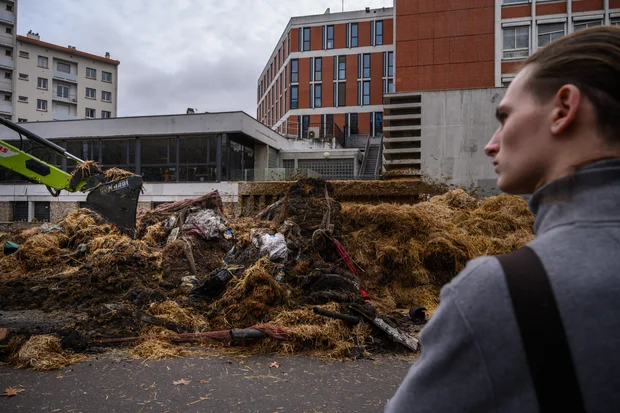
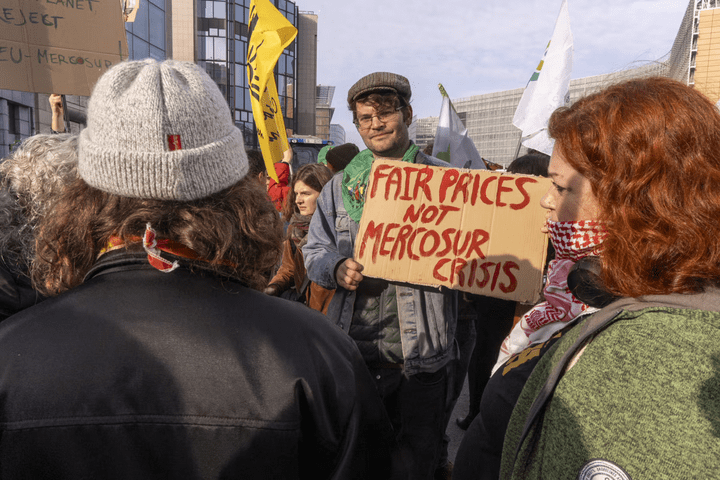
Thousands of farmers from across the European Union gathered in Brussels in December 2025 to block roads with their tractors and protest a proposed trade deal between the European Union and the South American Mercosur bloc. This large‑scale protest occurred at the same time as an EU summit where leaders discussed whether to sign or delay the contentious agreement.

The demonstrations reflected deep economic and political concerns among farmers about the potential impact of the trade deal on agriculture, rural livelihoods, and food security across Europe.
What the Protests Were About?
In mid‑December 2025, farmers from several EU countries drove tractors into central Brussels and blocked key roads, disrupting traffic near the European Council meeting where the future of the EU‑Mercosur trade deal was being debated.
The EU‑Mercosur agreement is a proposed free‑trade pact between the European Union and the Mercosur bloc, which consists of Brazil, Argentina, Paraguay, Uruguay, and Bolivia.
It was first negotiated in principle in 2019 after about 25 years of discussions, and it aims to gradually remove tariffs on most goods traded between Europe and South America over a period of around 15 years.
Farmers fear the agreement will lead to increased competition from cheaper agricultural imports (especially beef, sugar, rice, soya beans, and poultry) from Mercosur countries.
They argue that South American producers operate under different regulatory standards, including lower environmental and animal welfare requirements, which could allow products to enter the EU market with lower costs and undercut European farmers.
One Belgian farmer told media that they wanted “to be able to live off our work” and opposed the deal because of concerns about imports from countries with weaker environmental protections.
How the Protest Unfolded?
The demonstrations began early in the morning with farmers driving their tractors into Brussels and positioning them on major roads near EU institutions. Some media reported that more than 150 tractors clogged streets, while agricultural lobby groups estimated around 10,000 protesters were present in the European quarter.

The protest intensified as farmers blocked intersections and streets, bringing significant portions of central Brussels to a standstill.
In some cases, demonstrators threw objects such as potatoes or eggs and set small fires to draw attention to their message. Security forces used tear gas and water cannons to disperse crowds when tensions rose.
The presence of tractors and road blockages symbolized farmer resistance to what they see as a threat to their economic survival. The protest was not limited to Belgium.
Farmers from France, Italy, Poland, Austria, and Ireland also coordinated actions or expressed strong support for the demonstrations, indicating the scale of concern among agricultural communities across the EU.
Why Farmers are Worried?
Farmers oppose the Mercosur trade deal for several interconnected reasons:
1. Fear of Unfair Competition
Many farmers believe imports from South America will be cheaper because producers there may operate under less stringent regulations, lower labour costs, and weaker environmental protections.
This would make it harder for European farmers, who must meet strict EU rules, to compete.
2. Impact on Prices and Income
If cheaper agricultural goods enter the EU market, local prices could fall, reducing farm income. This concern is especially strong in sectors such as beef and dairy, where European producers already face tight margins and rising costs.
3. Regulatory and Quality Standards
Farmers argue that the standards for pesticides, antibiotics, animal welfare, and environmental protection in Mercosur countries differ from EU regulations.
They worry that imports produced under lower standards might compete directly with EU products, which are subject to higher costs due to regulatory compliance.
4. Long-Term Viability of Rural Areas
Many farmers say they feel overlooked by national and EU policies. They point to low incomes, rising fertilizer and energy costs, and uncertainty about future agricultural support as broader pressures that make additional competition even more threatening.
Political Reactions Within the EU
The protests did not occur in isolation. They coincided with a high‑level summit where EU leaders were debating whether to delay or proceed with signing the trade deal.
In the days leading up to the demonstrations, key EU member states publicly expressed reservations about the agreement.
French President Emmanuel Macron and Italian Prime Minister Giorgia Meloni both signaled that their countries were not ready to approve the deal in its current form, urging more safeguards for farmers and stronger environmental provisions.
As a result of rising opposition, EU leaders announced a delay in signing the agreement, pushing finalization to January 2026 to allow more time to address member states’ concerns. European Commission President Ursula von der Leyen said the deal needed broad support and additional safeguards before moving forward.
In response to the protests and political pressure, supporters of the deal, including leaders from Germany and Spain, stressed the broader economic and strategic benefits of the pact.
They argue that the agreement would help diversify trade, strengthen economic ties with South America, and boost European exports of industrial and agricultural products.
What the Mercosur Deal Proposes?
The EU‑Mercosur trade agreement is intended to be a comprehensive pact that goes beyond simple tariff reductions.
If fully implemented, it would gradually remove import duties on most goods traded between the European Union and the Mercosur countries over a period of around 15 years. It would also cover aspects of political cooperation and economic dialogue.
Supporters say the deal would open a market of around 780 million people and reduce tariff barriers for both sides, potentially saving billions in costs for importers and exporters. They argue that it could strengthen global trade linkages and reduce reliance on a single trading partner.
The agreement also includes proposed mechanisms to protect certain sensitive European products and allow temporary safeguards if sudden market disruptions occur.
However, critics contend that these protections may not go far enough to shield farmers from long‑term competitive pressures.
Broader Context of Farm Protests
The Brussels demonstration is part of a longer wave of agricultural protests across Europe throughout the early 2020s.
Farmers in France, the Netherlands, Poland, and other countries have repeatedly voiced concerns over EU policies ranging from environmental regulations to imports of non‑EU agricultural products. These broader protests were driven by worries about income, production costs, and policy reforms.
In France, for example, protests in recent years have combined opposition to certain agricultural policies with resistance to the Mercosur deal, reflecting a sustained climate of rural dissatisfaction.
Implications for EU Trade and Agriculture
The tractor protests in Brussels highlight the delicate balance the EU must strike between pursuing free trade agreements and supporting domestic sectors like agriculture.
Farmers are key stakeholders in EU economies and hold significant political influence, especially in countries where rural populations are large.
The delay in signing the Mercosur trade deal demonstrates how domestic pressures can affect international negotiations. EU leaders face the challenge of securing economic opportunities while ensuring that key constituencies, such as farmers, do not feel left behind.
This situation also raises questions about the future of trade policy in the EU, particularly in an era of rising global competition, environmental concerns, and changing geopolitical dynamics.
Proponents of the deal argue that broad trade relationships are necessary to maintain economic resilience. Opponents argue that local industries need more protections to thrive in a competitive global market.
Final Thoughts
The tractor protests in Brussels in December 2025 were more than a one‑off demonstration. They reflected deep economic, political, and social tensions within the European Union about how to balance free trade with agricultural sustainability.
The protests succeeded in delaying the trade deal, showing the impact that organized farmer mobilization can have on policy decisions.
As negotiations continue into 2026, both farmers and policymakers will be watching closely.
Whether Europe can find a compromise that supports trade growth while protecting local producers remains an open question; one with significant consequences for the future of European agriculture and its role in global markets.