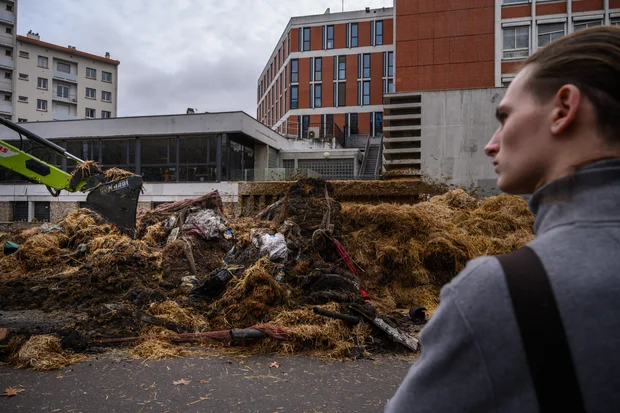
In December 2025, a massive farmers’ protest in Brussels over the European Union’s proposed Mercosur trade agreement escalated into violent clashes near the European Parliament. What began as a demonstration against EU agricultural policy and international trade terms grew into one of the most intense public order incidents seen in the Belgian capital in recent years.
The confrontation drew widespread attention and highlighted the deep divisions within the EU over agricultural policy, trade liberalization, and rural economic sustainability.
Farmers and the Mercosur Trade Deal
The protests in Brussels were primarily aimed at the EU‑Mercosur trade agreement, a proposed free trade pact between the European Union and the Mercosur bloc of South American nations, including Brazil, Argentina, Uruguay, and Paraguay.
Negotiations for this agreement have spanned decades, and if implemented it would remove tariffs on most goods traded between the two regions over approximately 15 years.
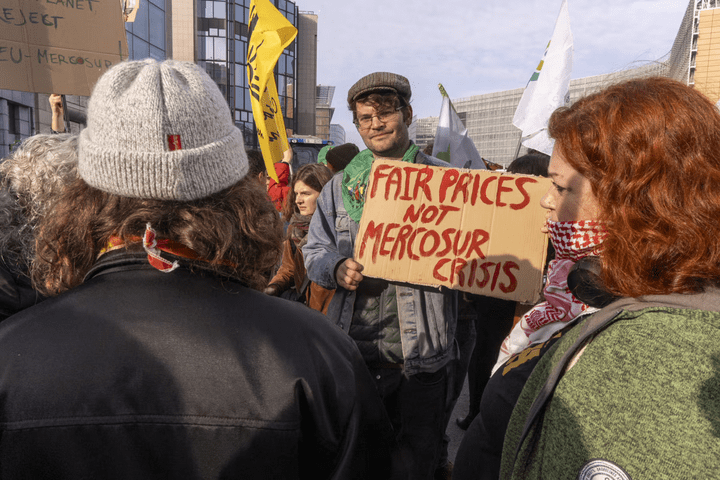
Supporters argue it would expand markets for European exporters and strengthen economic ties, while critics (especially many farmers) fear it would expose European agriculture to unfair competition.
European farmers have long expressed concerns that imports from Mercosur countries could be cheaper because producers there often operate under different regulatory standards, especially in areas such as environmental protection, food safety, and animal welfare.
They argue these differences could enable imported agricultural products to enter European markets at lower prices, potentially undercutting domestic producers who must comply with stricter EU regulations.
The protests took place as EU leaders gathered in Brussels for a summit where the pace and terms of the Mercosur agreement were being debated, including whether to delay signing to allow more time for implications to be addressed.
European Commission President Ursula von der Leyen suggested postponing the signing to continue consultations with member states and address key concerns raised by farmers and political leaders.
Scale and Participants
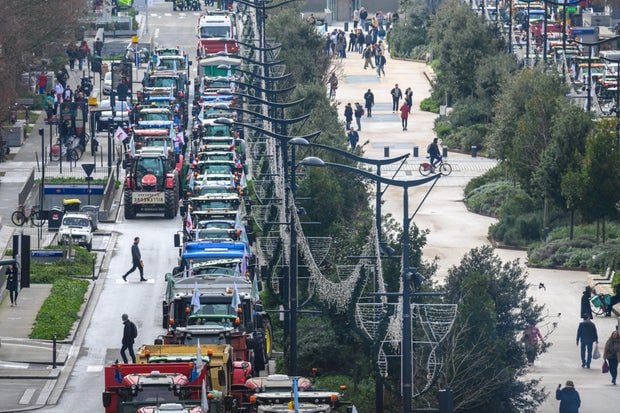
The protest drew thousands of farmers from across the European Union. According to police and media reports, more than 7,000 farmers and around 1,000 tractors converged on Brussels on the day of the demonstration.
Many had traveled considerable distances to reach the city, joining organized delegations from countries including France, Belgium, Spain, and Poland.
Protesters gathered near major transit points such as Brussels North Station and advanced toward the European quarter, signaling their intent to demonstrate near the institutions where high‑level policy decisions were being discussed. They used tractors to block roads, creating physical obstructions that slowed traffic and limited access to key government buildings. In parts of the city, blockades persisted for hours.
The demonstration’s official start was scheduled in the early afternoon, but many participants were already present in the European quarter earlier in the morning.
When the official procession was dispersed on the Brussels small ring road in the early afternoon, hundreds of farmers continued their movement toward Place du Luxembourg, near the European Parliament, where tensions later escalated.
Escalation Into Violence
The protest, which began peacefully, grew intense when some demonstrators attempted to breach police roadblocks near the European Parliament and other EU institutions.
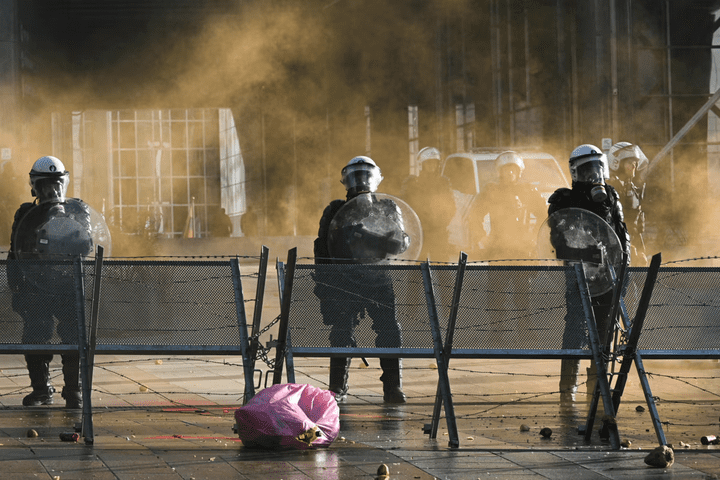
Police used water cannons and tear gas to control crowds and prevent tractors from entering restricted areas. Tear gas is a chemical irritant used by law enforcement to disperse crowds by causing temporary eye and respiratory irritation.
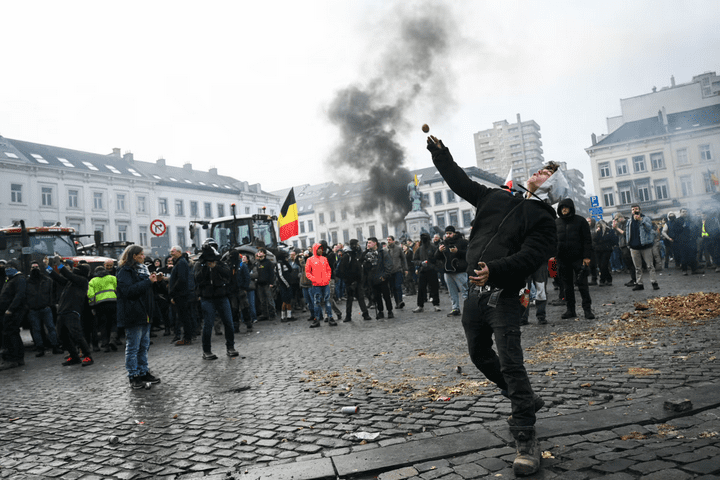
Clashes included exchanges of thrown objects such as potatoes, eggs, and other farm produce, and fires were set in some locations, contributing to a chaotic environment. At least one demonstrator was reported injured with visible head wounds during confrontations. Police also reported injuries among officers and damage to equipment, indicating the level of force used on both sides.
In total, authorities made 13 arrests during and immediately after the protest, classified into administrative arrests and judicial arrests.
Administrative arrests relate to short‑term detentions for maintaining public order, while judicial arrests involve cases where individuals may face formal charges and prosecution.
Police Tactics and Public Order Measures
Belgian police coordinated their response with crowd control units trained to manage large demonstrations, particularly those involving heavy machinery and vehicles.
Using water cannons is a standard practice in European law enforcement for controlling violent crowds without lethal force. Tear gas is also commonly employed when physical barriers and verbal warnings fail to halt aggressive actions.
Authorities had established perimeter controls near sensitive locations such as the European Parliament and Place du Luxembourg to prevent direct access by tractors and large crowds.
In several instances, tractor drivers attempted to force their way through these perimeter controls, prompting police to escalate their response. The objective was to protect public safety, preserve the integrity of key buildings, and maintain traffic routes for emergency services.
Public safety concerns also included the risk of serious injury from collisions involving heavy farm vehicles and unpredictable crowd movements in densely populated sections of the city center.
Managing such risks required careful deployment of law enforcement personnel and equipment throughout the day.
Political Reactions Across Europe
The violent turn of events in Brussels drew reactions from policymakers across the EU. Many politicians emphasized the right of citizens to protest peacefully but condemned the use of violence and property damage.
A spokesperson for Copa‑Cogeca, a major European agricultural organization, expressed understanding for the farmers’ anger but clarified that violent acts were not part of the planned peaceful protest.
Meanwhile, political leaders from countries with strong agricultural sectors confirmed their reservations about the Mercosur agreement amid the unrest.
French President Emmanuel Macron and Italian Prime Minister Giorgia Meloni were among senior EU figures indicating that their governments were not ready to ratify the deal without additional safeguards for farmers, including measures to protect local agricultural markets and environmental standards.
In response to the protest and related political pressure, EU officials announced proposals to postpone signing the Mercosur agreement until January 2026. This decision was intended to allow further discussion of farmers’ concerns and potential adjustments to the trade pact to address perceived competitive disadvantages.
The Mercosur Agreement and Key Disagreements
The Mercosur agreement is one of the most ambitious trade negotiations involving the EU, covering a large market of roughly 780 million people and up to a quarter of global economic output.
If implemented, the deal would progressively remove tariffs on most goods, including agricultural products, over a period of years.
Tariffs are taxes imposed on imported goods, intended to protect domestic producers by making foreign products more expensive. Removing tariffs under a trade agreement typically lowers the cost of imported goods, which can benefit consumers through lower prices but also increases competition for domestic producers.
Farmers opposing the deal argue that cheaper agricultural imports from Mercosur countries could displace European products in the market, particularly if imported goods do not meet equivalent standards for environmental protection, animal welfare, food safety, and labour conditions.
These regulatory differences are central to the debate because compliance with EU standards often requires additional investment by local producers.
European leaders supporting the deal emphasize its strategic importance for diversifying trade relationships and strengthening economic ties beyond current partners. They argue that broader trade engagement can spur export opportunities for European industries and boost economic growth. However, critics say the deal needs stronger protections for sensitive sectors like agriculture.
Wider Context of European Farmers’ Protests
The Brussels protest is part of a broader pattern of farmers’ demonstrations across Europe over the past few years. Farmers have expressed repeated dissatisfaction with aspects of the Common Agricultural Policy (CAP), environmental regulations, and international trade agreements perceived to disadvantage local producers.
The CAP is a long‑standing EU framework that provides subsidies and support to farmers across member states, intended to stabilise markets, ensure food security, and maintain rural livelihoods.
Changes to the CAP or perceived inadequacies in support levels have often triggered protests in various countries.
In addition to Brussels, farmers’ protests have occurred in France, Poland, the Netherlands, and other member states, reflecting shared concerns about global competition, import policies, and the financial viability of small and medium‑sized agricultural operations.
Impact and Aftermath
The violent clashes in Brussels had immediate consequences for both public order and political momentum. Law enforcement faced criticism for heavy‑handed tactics from some civil liberties groups, while others defended the police response as necessary to prevent further escalation and protect key institutions.
At least one reported injury to a protester illustrated the physical risks inherent in confrontational demonstrations.
The decision to delay the Mercosur agreement represents a partial political response to the unrest, signalling that farmers’ voices and broader public opinion can influence policy timelines.
Whether this delay will lead to substantive changes in the agreement’s terms remains to be seen.
The protests also sparked a public discussion about how to balance economic liberalisation with protection for local industries, the role of large trade agreements in domestic markets, and the responsibilities of governments to address constituent concerns without discouraging open markets.
Final Thoughts
The violent turn of the farmers’ protest near the European Parliament in Brussels illustrates the depth of concern among agricultural communities regarding EU policy and international trade agreements.
What began as an expression of economic and regulatory anxiety evolved into a confrontation with police and a catalyst for political reconsideration of a major trade pact.
As negotiations continue into 2026 and beyond, policymakers will need to weigh the economic benefits of expanded trade against the social and economic stability of key sectors like agriculture.
How the EU resolves these tensions will shape not only future trade policy but also wider public trust in governance and democratic dialogue.