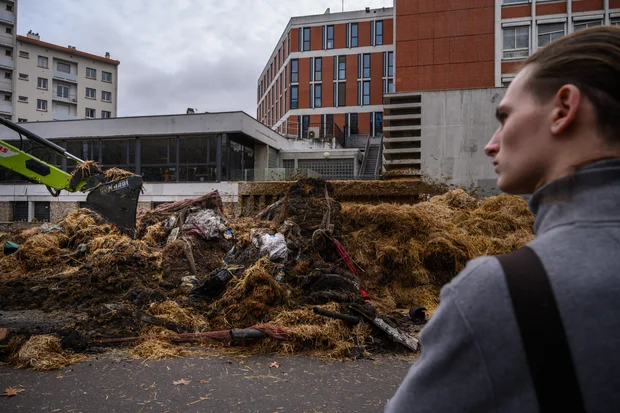
Dozens of French farmers drove to Le Touquet, the holiday residence of President Emmanuel Macron and his wife Brigitte, and dumped manure, garbage, tires and cabbages in the street outside the property.

They also placed a coffin bearing the words “No to Mercosur” as a symbol of their rejection of an international trade agreement they fear will hurt French agriculture.
What Happened at Le Touquet?
On Friday, December 19, 2025, dozens of French farmers converged on the seaside town of Le Touquet, northern France, where President Emmanuel Macron maintains a holiday home.
Under police supervision, the protesters dumped stacks of manure, old tires, branches, cabbage heads and assorted farm waste on the pavement and roadway outside the president’s residence.
The environment was calm but charged with symbolic meaning. Alongside the manure piles, they placed a coffin marked “No to Mercosur” to underline what they see as the potentially fatal impact of the proposed EU‑Mercosur trade deal on French agriculture.
The protest was meant to send a direct message to Macron and the French government: farmers feel ignored on key agricultural policies, and they believe drastic action is necessary to draw attention to their plight.
Why Farmers Were So Angry?
1. Fear of the EU‑Mercosur Trade Deal
The most visible trigger for the manure protest was opposition to the European Union‑Mercosur Association Agreement, a long‑negotiated trade deal between the EU and the South American Mercosur bloc, which includes Brazil, Argentina, Paraguay and Uruguay.
Under the proposed agreement, tariffs on many goods traded between the two regions would be reduced or eliminated. While the deal has potential economic benefits in other sectors, many farmers oppose it because they fear a flood of cheaper agricultural imports such as beef, soy, poultry, rice and honey.
They argue these products are often produced to less stringent environmental and animal welfare standards than those required in the EU, giving them an unfair price advantage and threatening domestic producers.
For many farmers, the coffin symbolized what they see as the potential death of French family farming if the agreement is ratified without adequate protections and safeguards.
2. Economic Pressures on Farming Families
Just behind trade anxiety lies a broader sense of economic insecurity. Costs for fuel, fertiliser, equipment and labour have all risen sharply in recent years, squeezing farm profit margins.
At the same time, incomes for many producers have stagnated or fallen due to competitive pressures from larger industrial farms and cheap imports.
These long‑term financial stresses made many farmers feel like they were fighting lose‑lose battles.
3. Resentment Over Policy Handling
The protest also comes on the heels of a wider wave of farmer unrest in France in 2025, including demonstrations against how the government managed outbreaks of lumpy skin disease among cattle, and demands for better compensation and less heavy‑handed control measures.
Some farmers felt disease control policies, such as mandatory mass culls when infection is detected, were insensitive to their livelihoods and economic stability.
4. Feeling Ignored by Policymakers
Many farmers tell me they feel increasingly overlooked by national and EU policymakers who pursue trade deals, regulatory changes and climate policies without what farmers see as adequate input from those who actually produce the food.
They feel distant from the centers of power in Paris and Brussels and believe loud, symbolic actions are the only way to be heard.
How the Protest Unfolded?

This protest in Le Touquet did not occur in isolation. It was part of a broader pattern of demonstrations and farm actions across France and Europe in late 2025.
1. Spread of Protests Across France
Farmers organized road blockades, tractor convoys and local demonstrations well before the manure‑dumping event. These actions often targeted highways, administrative buildings and publicly visible spaces to draw attention to their demands.
The protests were not limited to one union or group.
Members of major agricultural unions such as the FNSEA, Coordination Rurale and Confédération Paysanne took part, alongside independent producers and regional farming collectives. Their demands included better income support, slower regulatory changes, disease management reform and protection from cheap imports.
2. Connection to Brussels Demonstrations
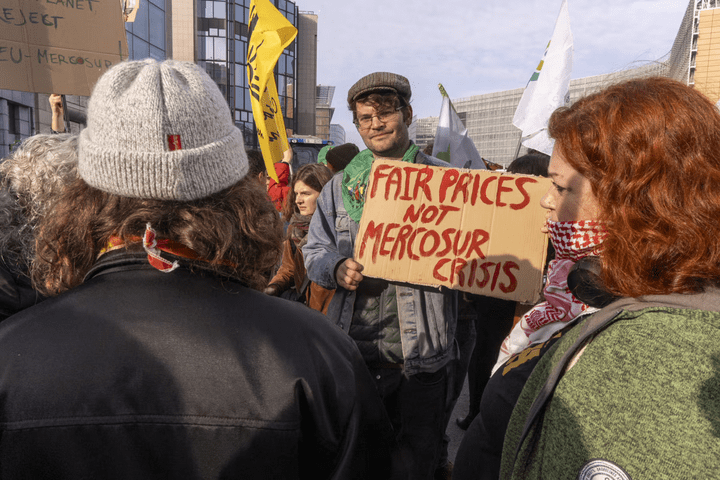
Just a day before the Le Touquet action, European farmers held a large protest in Brussels, involving French and other EU farmers calling on leaders meeting there not to approve the Mercosur deal.
That protest, which included tractors blocking major roads, fires and direct actions at EU institutions, contributed to the European Commission postponing the signing of the trade agreement until January 2026.
Many farmers in Le Touquet said their protest was an extension of the pressure campaign that began in Brussels and was meant to keep the issue in the spotlight as national political leaders prepare for further negotiations.
Symbolism Behind the Manure and Coffin
When I first heard about manure and cabbages being dumped in public, some readers might think it was merely chaotic spectacle.
In fact, agricultural protests often use strong symbols to underscore serious economic grievances:
- Manure has long been a protest symbol for farmers because it represents both their daily work and the perceived “waste” status of their concerns in public policy discussions.
- Coffins, especially with slogans like “No to Mercosur,” signal what protesters see as a threat to the survival of their profession and way of life.
These tactics are not new. French farmers have dumped manure and produce outside government offices and blocked roads as forms of protest in earlier demonstrations tied to agricultural policy.
Government and Political Reactions
The French government has been in a delicate position. On one hand, officials want to maintain public order and protect travel and commerce, especially during the holiday season.
On the other hand, they face continued unrest among one of the country’s most politically influential groups.
In response to the broader protests, including manure dumps and road blockades, the government called for a Christmas truce, warning against further disruptive blockades over the holidays while negotiations with agricultural unions continue.
Some farming organizations agreed to a temporary pause, but others remain cautious about halting protests without firm commitments on their demands.
On the trade front, President Macron has publicly stated that France will not support the Mercosur trade deal unless strong safeguards are put in place to protect European farmers from cheap imports and to ensure imported products meet high EU standards.
As a result, the signing of the agreement was delayed until January, giving governments more time to address internal opposition.
Government efforts to address lumpy skin disease among cattle, including deploying the army to support an accelerated vaccination campaign across rural areas, are also part of attempts to respond to farmers’ concerns about disease control policies.
Broader Context of French and European Farmer Protests
These protests reflect long‑standing frustrations among farmers that go beyond a single trade deal.
Throughout 2024 and 2025, farmers in France and across the European Union have staged demonstrations against various government policies, including environmental regulations, cuts to fuel subsidies, tax changes, and trade liberalization.
The movement combines economic grievances with broader political concerns about global competition, rural depopulation, market consolidation and what farmers see as an imbalance in policy priorities that favors urban and industrial sectors over rural producers.
What It Means Going Forward?
As 2025 draws to a close, the manure protest at Macron’s holiday home highlights a few key dynamics shaping European agriculture:
- Farmers are willing to use highly visible symbolic protests to draw attention to issues they feel governments are ignoring.
- The opposition to the Mercosur agreement has political weight and has already influenced the timing of international negotiations.
- Broader economic and disease management grievances are intertwined with trade concerns, meaning solutions must address multiple dimensions of farmers’ struggles.
- Policymakers will need to rebuild trust and engage in sustained dialogue if they want to find durable solutions that protect local producers while balancing international trade and environmental goals.