In late 2025, a wave of lawsuits and public concern emerged across the United States after thousands of farmers and agricultural workers developed Parkinson’s disease, a progressive neurodegenerative disorder.
Many plaintiffs allege that long‑term exposure to paraquat, a widely used herbicide, is the underlying cause of their condition.

Paraquat has been banned in dozens of countries due to toxicity concerns, yet it remains legal and widely used in U.S. agriculture.
The growing legal, scientific, and public health debate surrounding paraquat’s safety has profound implications for farmers, regulatory agencies, public health policy, and the agricultural industry as a whole.
Paraquat and Its Agricultural Role
1. What is Paraquat?
Paraquat is a fast‑acting herbicide used by farmers to control weeds and clear fields before planting or harvest. It is particularly effective as a “burn down” agent that kills vegetation quickly and is valued for its cost efficiency and reliability.
Despite its effectiveness, paraquat is known to be highly toxic to humans. Ingestion, inhalation, or skin contact can cause serious health effects, including lung damage, liver failure, kidney failure, and death.
Even at lower exposure levels, the chemical can cause severe inflammation and systemic toxicity.
2. A Chemical Banned Abroad But Used at Home
While more than 70 countries (including members of the European Union and China) have banned paraquat because of safety concerns, the United States continues to allow its use under regulations that restrict its application to certified applicators and require safety measures aimed at preventing accidental ingestion.
Regulatory agencies such as the U.S. Environmental Protection Agency (EPA) have imposed labeling requirements (e.g., blue dye, strong odor, and added emetics) to signal toxicity and discourage accidental swallowing.
However, critics argue that these measures do little to address long‑term, chronic exposure risks experienced by agricultural workers.
Farmers and Families Speak Out
Personal Stories and Lawsuits
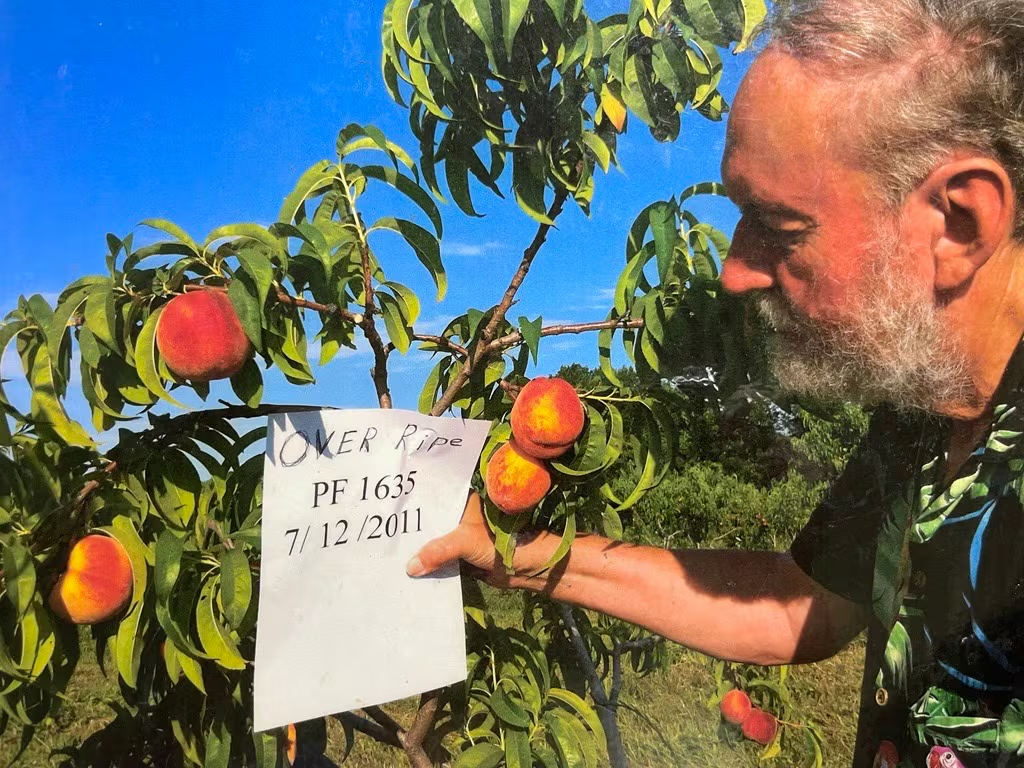
Farmers like Mac Barlow, who used paraquat intermittently over four decades, report being diagnosed with Parkinson’s disease despite no family history of neurological disorders.
Barlow’s story reflects the experiences of many plaintiffs who are now part of a growing wave of legal claims against chemical manufacturers.
By late 2025, more than 6,400 paraquat‑related lawsuits were filed in the U.S. District Court for the Southern District of Illinois alone, with additional claims pending in states like Pennsylvania and California.
Plaintiffs allege that manufacturers (notably Syngenta and others) failed to adequately warn users about the long‑term neurologic risks of paraquat exposure.
In their complaints, many describe how decades of handling the herbicide (even with protective gear) preceded debilitating symptoms and diagnoses, leaving them struggling with everyday tasks, facing mounting medical costs, and watching their careers and independence slip away.
Scientific and Legal Controversies

1. Plaintiffs’ Perspective
Farmers and advocacy groups contend that paraquat’s continued use in the U.S., represents a glaring regulatory failure that places agricultural workers at risk.
They point to studies correlating paraquat exposure with Parkinson’s and other health risks as evidence that the chemical should be withdrawn from the market.
Critics highlight research suggesting paraquat may contribute to neuronal damage through oxidative stress mechanisms — mechanisms similar to laboratory agents that reliably induce Parkinson’s‑like symptoms in animals.
Some public health advocates argue that U.S. pesticide regulations lag behind international standards and fail to account adequately for chronic, low‑dose exposures experienced by workers over decades.
2. Defendants’ Position
Chemical manufacturers, led by Syngenta, reject claims of a causal link between paraquat and Parkinson’s disease. They assert that hundreds of studies over decades have not established definitive causation and that paraquat is safe when used as directed.
Syngenta also highlights regulatory endorsements from authorities in the U.S., Australia, and Japan supporting this view.
In legal filings, defendants argue that epidemiological associations do not prove that paraquat exposure directly causes Parkinson’s. They maintain that Parkinson’s has a complex and multifactorial etiology, and label directions and safety protocols sufficiently mitigate acute risks when properly followed.
This divide between scientific interpretations (causal vs. associative) sits at the heart of the legal battle.
Impact on Individuals and Communities

1. Health and Quality of Life
Parkinson’s disease dramatically affects sufferers’ quality of life, eroding motor function and independence. Patients often require long‑term medical care, physical therapy, medications, and sometimes surgical interventions.
For farmers diagnosed in mid‑life, the impact extends beyond personal health, affecting livelihoods, family dynamics, and financial stability.
2. Economic and Emotional Toll
The emotional burden on families and caregivers is immense. Many plaintiffs recount watching loved ones deteriorate physically and mentally, often at the peak of their working lives.
Lawsuits reflect not only demands for compensation but also a yearning for accountability and recognition of harm.
Beyond individuals, rural communities with higher pesticide use may face broader healthcare challenges and economic strains as more workers experience chronic health conditions potentially linked to agricultural chemicals.
Current Events and Legal Developments
1. Multidistrict Litigation (MDL)
Thousands of paraquat cases have been consolidated into multidistrict litigation (MDL‑3004) in federal court. MDL proceedings aim to streamline evidence and pretrial steps across similar cases, though individual suits may still proceed to trial or settlement.
Some cases have already settled (for example, a 2021 resolution awarded $187.5 million to plaintiffs) but many remain unresolved, with settlements and trials expected to unfold over the coming years.
2. Regulatory Review and Calls for a Ban
Amid litigation, there are renewed calls from health advocates and some lawmakers for stricter regulations or even a full ban of paraquat in the United States, mirroring actions taken by other countries that have prioritized public health concerns over continued agricultural use.
The EPA has faced criticism for not acting more decisively, with advocates arguing that delay in regulatory action leaves workers and communities vulnerable to avoidable harms.
Key Issues at a Glance
| Issues | Contention |
|---|---|
| Paraquat usage | Banned in 70+ countries but still used in U.S. agriculture. |
| Health risk claim | Plaintiffs allege exposure increases Parkinson’s risk. |
| Scientific debate | No scientific consensus on causation; evidence mixed. |
| Litigation | Thousands of lawsuits consolidated in MDL. |
| Regulatory response | EPA maintains paraquat is safe when used as directed. |
| Public health advocacy | Calls for U.S. ban and stronger worker protections. |
A Crossroads of Health, Law, and Agriculture
The surge in Parkinson’s diagnoses among U.S. farmers and the mounting paraquat lawsuits highlight a profound intersection of environmental exposure, public health, regulatory policy, and corporate accountability.
Farmers and advocacy groups argue that long‑term exposure to paraquat, has taken a heavy toll on rural communities, while manufacturers and some regulators emphasize that scientific evidence does not definitively prove causation.
At stake are the well‑being of agricultural workers and their families, the integrity of scientific risk assessment, and the future of pesticide regulation in the United States.
As litigation continues and scientific research evolves, these debates will likely shape agricultural practices, worker protections, and regulatory standards for years to come.
In the midst of legal battles and policy discussions, one reality stands clear: farmers and rural communities deserve robust protections and transparency; informed by science, shaped by public health priorities, and grounded in a just balance between productivity and safety.