While most oceans are warming, one part of the North Atlantic is doing something unexpected: it is getting colder.
South of Greenland and Iceland, the so-called “cold blob” has cooled by nearly 1 degree Celsius since around 1900. Scientists have debated its cause for years, but new research suggests the cooling reaches deep below the surface and is mainly linked to changes in ocean heat transport.
This strengthens concerns that the Atlantic Meridional Overturning Circulation, or AMOC, may be weakening. To me, that is what makes this story so important.
One cold patch may seem small on a global map, but it could be a warning sign of much larger changes moving through the ocean system.
What is the North Atlantic Cold Blob?
The name “cold blob” sounds harmless, but the science behind it is anything but small.
South of Greenland, a vast region of the North Atlantic is cooling while most of the world’s oceans continue warming. Scientists believe this unusual pattern may be a fingerprint of a weakening Atlantic Meridional Overturning Circulation, or AMOC, which carries heat northward through the ocean.
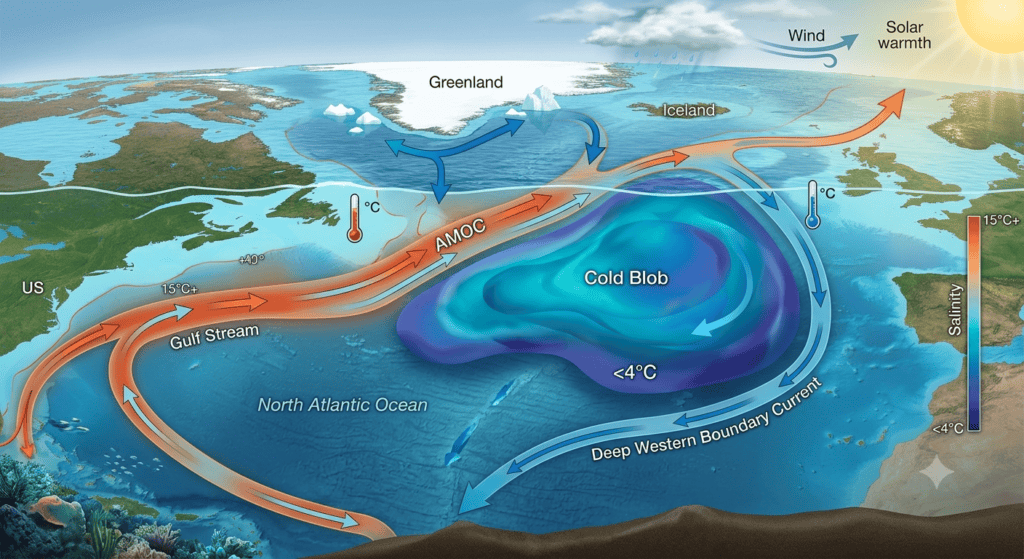
To understand the cause, researchers combined data from satellites, ships, buoys, and climate models. They found that the cooling extends far below the surface, where winds and clouds have less influence.
To me, that is the most important clue. This is not simply a surface weather pattern. It may reflect a deeper shift in how heat moves through the Atlantic Ocean.
What Is the AMOC and Why Does It Matter?
The AMOC is easier to understand when I picture it as the Atlantic Ocean’s giant conveyor belt.
It carries warm tropical water northward, releases heat into the atmosphere, then sends colder, denser water back south through the deep ocean. This movement helps shape temperatures, rainfall, storms, sea levels, and regional climates across several continents.
The concern is that global warming may be disrupting the system.
Warmer water is less likely to sink, while melting Greenland ice and heavier rainfall add freshwater that makes the North Atlantic even less dense.
Scientists are still working to measure these changes precisely, but several studies suggest the AMOC has weakened over time. To me, that matters because even a slow change in this enormous ocean system could reshape climate far beyond the North Atlantic.
Why the New Study Is Important?
Climate science is rarely built on one dramatic discovery. It grows stronger as different pieces of evidence begin pointing in the same direction.
The new cold blob study adds an important piece. Researchers found that increased heat loss from the ocean surface cannot fully explain the long-term cooling.
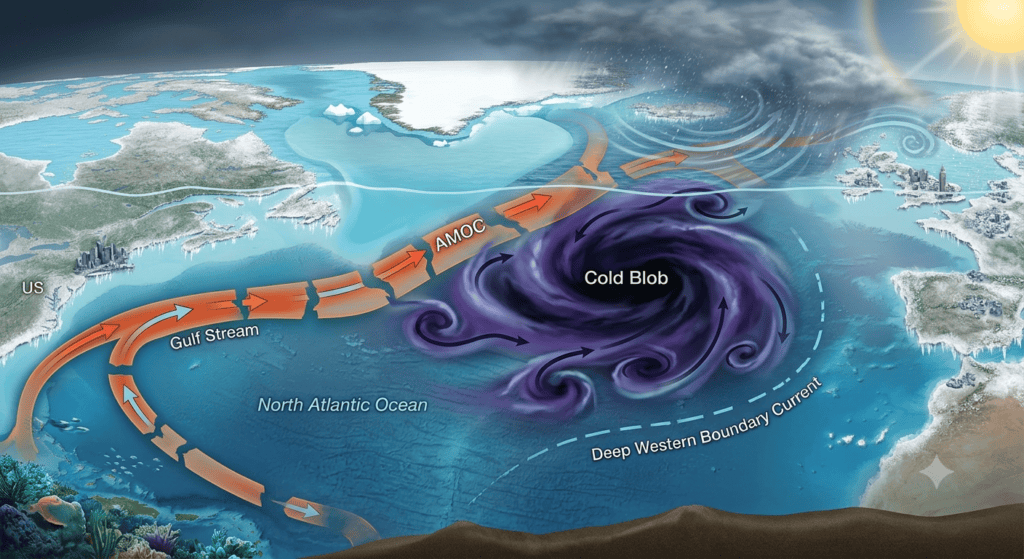
Instead, less warm water appears to be reaching the region, supporting the idea that a weaker AMOC is involved.
Cooling beneath the surface strengthens that explanation, although the historical data is not perfect. Measuring an enormous ocean system across many decades remains difficult.
To me, uncertainty does not make the warning meaningless. It makes continued research even more important. The study may not close the debate, but it gives scientists another strong reason to keep watching the Atlantic closely.
What Could Happen if the AMOC Becomes Much Weaker?
A weaker AMOC could reshape weather and climate far beyond the North Atlantic. Parts of Europe may experience colder conditions even as the planet continues warming, while sea levels could rise along sections of the North American Atlantic coast.
Rainfall and monsoon patterns may also shift, affecting farming and water supplies across parts of Africa, Asia, and South America. Fisheries, marine ecosystems, storms, and the ocean’s ability to absorb carbon could change as well.
Scientists are still uncertain about whether the AMOC could collapse or when that might happen.
To me, that uncertainty is not reassuring. It does not mean the risk is absent. It means we should take the warning seriously before the consequences become impossible to ignore.
The Cold Blob Does Not Mean Global Warming Has Stopped
One cold patch does not cancel a warming planet. It may reveal how deeply the climate system is changing.
The North Atlantic cold blob stands out because most of the world’s oceans are still absorbing more heat. Scientists believe this unusual cooling may be linked to weaker ocean circulation carrying less warmth into the region.
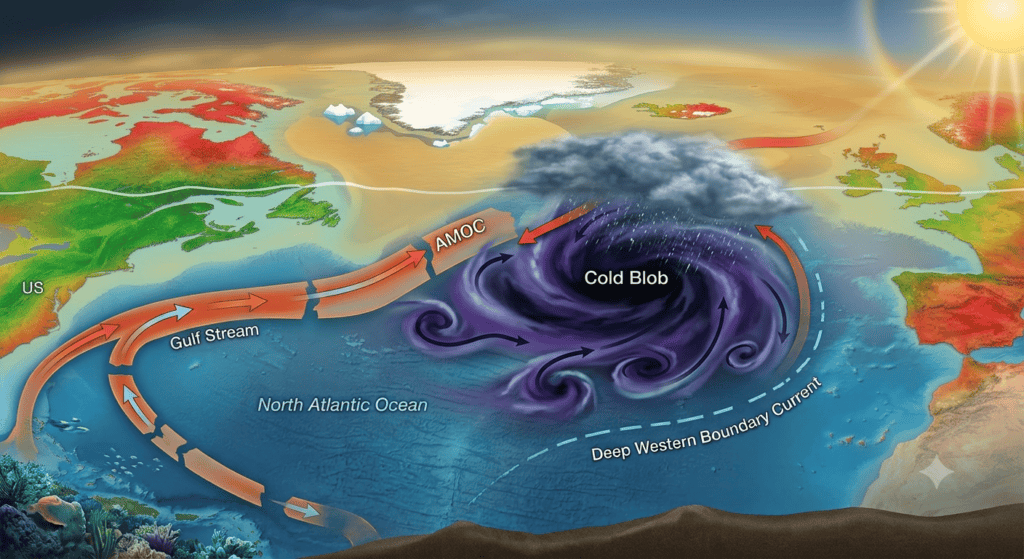
That means the cold blob is not evidence against global warming. It may be one of its consequences.
To me, this is an important reminder that climate change does not affect every place in the same way. It can bring heat waves, heavier rain, drought, or even regional cooling.
One location never tells the whole story. The larger pattern does.
My Practical Tips for Understanding Climate Headlines
When I see words like “collapse” or “tipping point,” I try to read beyond the headline. Weakening does not automatically mean the AMOC is about to stop, and scientific uncertainty does not mean nothing is happening.
The best approach is to compare reliable sources, understand what is known, and remain honest about what is still uncertain.
To me, the goal is not panic.
It is informed concern.
Fear can leave us feeling powerless. Understanding can lead to action, including reducing greenhouse gas emissions and protecting the climate systems we all depend on.
A Warning Worth Taking Seriously
The North Atlantic cold blob does not answer every question about the AMOC, but new research strengthens the link between this unusual cooling and changes in ocean heat transport.
It is no longer just a strange patch on a climate map.
To me, the message is not that catastrophe is certain. It is that Earth’s climate is deeply connected. A shift near Greenland could influence European temperatures, American sea levels, African rainfall, and weather far beyond the Atlantic.
The ocean quietly moves heat around the planet every day. When that movement begins to change, noticing the signal early matters. The cold blob still holds mysteries, but it is giving scientists another reason to watch the AMOC closely and take climate risks seriously.