During the partial solar eclipse of October 25, 2022, researchers monitored Norway spruce trees in Italy’s Dolomites. They found that electrical signals in different trees became increasingly synchronized before and during the event.
Older trees appeared to respond earlier and more strongly.
To me, the finding makes a forest feel less like a collection of separate organisms and more like a deeply connected living system.
Still, the science should not be overstated. Researchers recorded the synchronization, but they have not yet proved what caused it or whether the trees were truly communicating.
The study does not give us a final answer. It gives us a remarkable new question: how connected might a forest really be?
The Day the Forest Appeared to Move in Unison
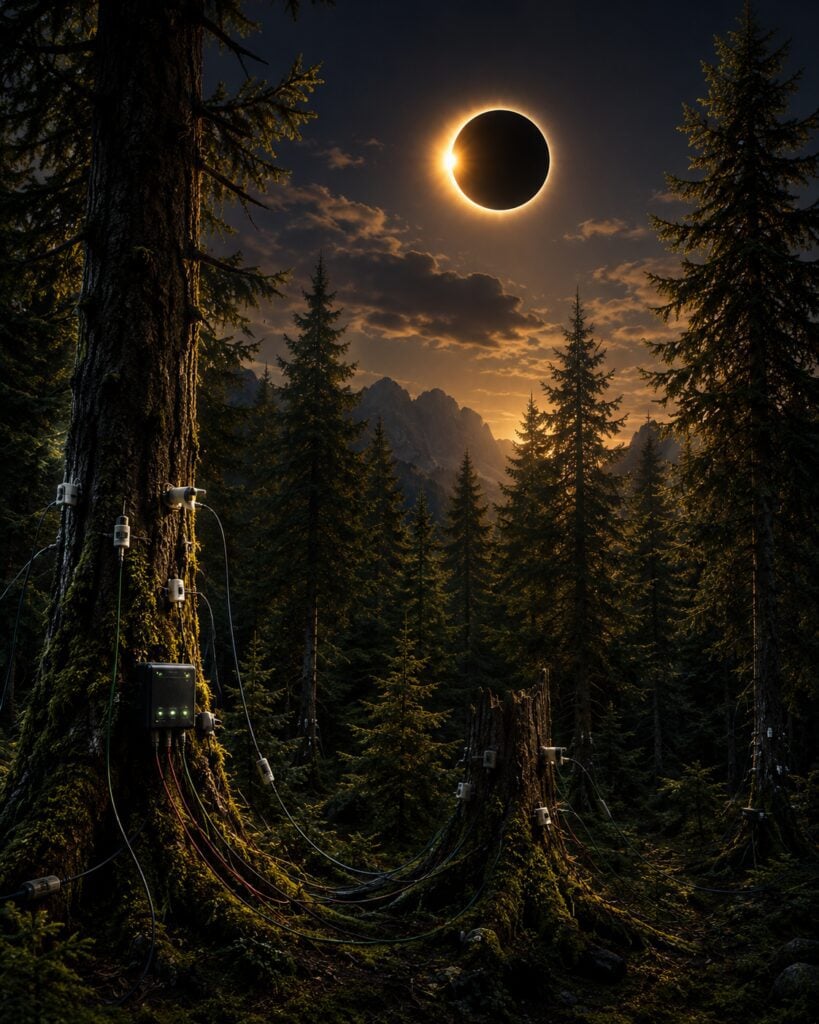
In Italy’s Costa Bocche forest, researchers attached sensors to three living Norway spruce trees and five old stumps, measuring tiny electrical changes across trunks, branches, and exposed roots.
Before and during the partial solar eclipse, signals from separate trees began forming increasingly similar patterns.
The team described this as bioelectrical synchronization, almost like individual instruments gradually following the same beat.
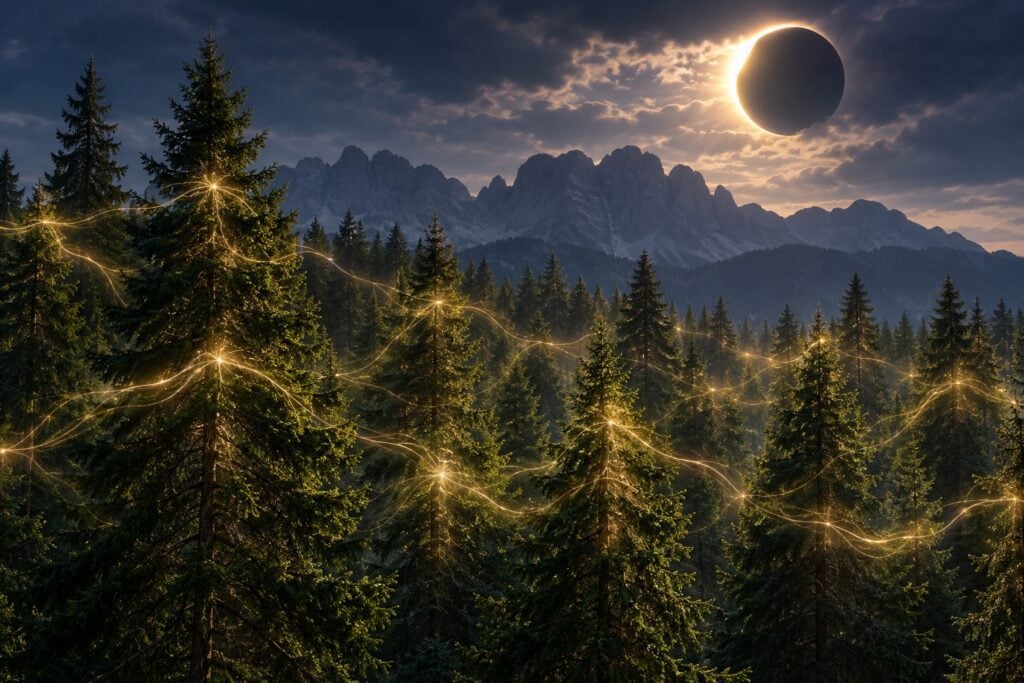
To me, the finding is remarkable because it suggests trees may respond to sudden environmental change as a connected system. Still, it should not be exaggerated.
The synchronized signals were recorded, but scientists have not yet proven that the trees were communicating or anticipating the eclipse. What they found was not a final answer, but a fascinating sign that forest life may be far more coordinated than it appears.
What Are Bioelectrical Signals in Trees?
Trees do not need wires or sparks to carry electrical signals. Inside their cells, charged particles called ions move across membranes, creating tiny changes in voltage. These signals help plants respond to light, temperature, water, injury, and other environmental changes.
I think of this bioelectrical activity as a quiet internal messaging system.
Trees do not have brains or nerves like humans, and the signals do not prove they think as we do. They show that different parts of a plant can detect change and coordinate a response.
What made the Italian study especially fascinating was that researchers measured this hidden activity across several trees at once.
Instead of studying each tree alone, they asked whether an entire forest might respond in a shared rhythm.
Did the Trees Really Anticipate the Eclipse?
Researchers found that tree signals became synchronized before the eclipse, with unusual coordination appearing up to 14 hours earlier.
Older trees showed stronger changes, leading to the idea that mature trees might help coordinate the forest. But saying they “anticipated” the eclipse goes too far.
The study did not prove that trees knew it was coming or that the eclipse directly caused the pattern.
In 2026, other scientists suggested possible alternatives, including weather, atmospheric electricity, storms, or nearby lightning. The original team agreed that synchronization alone does not prove communication.
To me, that debate does not weaken the discovery.
It shows science working as it should: an unusual pattern is observed, bold ideas are tested, and stronger evidence is demanded before conclusions become facts.
Could a Forest Behave Like a Living Collective?
A forest may look still, but beneath that silence, countless relationships are constantly at work.
Trees interact with fungi, soil organisms, insects, water, air, and neighboring plants. Their roots can alter the soil, fungal networks may connect them underground, and airborne chemicals from one plant can influence another.
That does not mean a forest has a single mind. “Forest intelligence” is a compelling idea, but a more accurate description is that forests are deeply connected biological systems.
Like a flock of birds turning together, complex group patterns can emerge from many simple local responses.
To me, that is what makes this research so important. Whether trees directly communicated during the eclipse remains uncertain. But studying forests as communities, rather than isolated individuals, may reveal patterns we have been missing all along.
Why Older Trees May Matter More Than We Realize?
In the spruce study, older trees showed stronger early electrical changes than the younger tree. Researchers suggested this might reflect a form of ecological memory, although that idea remains unproven.
What is certain is that mature trees provide far more than shade.
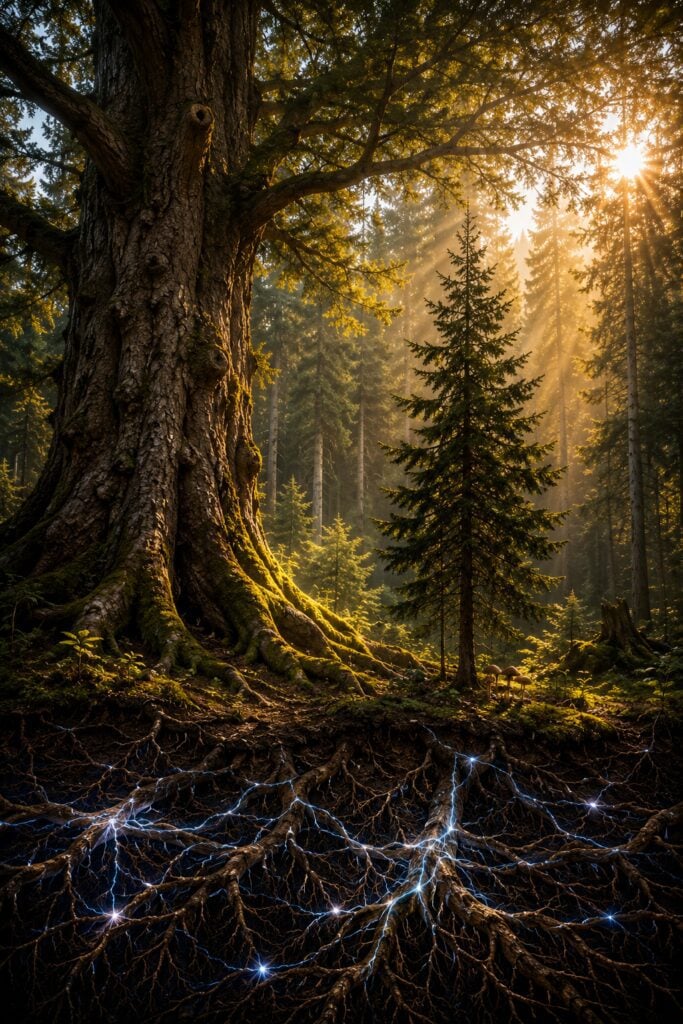
They store decades of carbon, stabilize soil, regulate water, and support fungi, insects, birds, and microorganisms. Their ecological relationships cannot be replaced the moment a seedling enters the ground.
To me, the lesson is simple: planting new trees matters, but protecting old ones matters just as much. Reforestation prepares for the future. Preservation protects what is already working today.
What This Research Can Teach Us?
The most honest conclusion is not that trees predicted an eclipse. It is that the forest showed us something we do not yet fully understand.
Researchers recorded unusual electrical synchronization, but the cause remains uncertain. Future studies will need more trees, multiple locations, and measurements of weather, lightning, soil moisture, temperature, sap flow, and atmospheric electricity.
Total eclipses may provide even clearer tests.
To me, this is science at its best. An unexpected pattern creates a question, not an instant fact. Later research may confirm the original idea or replace it with a better explanation.
Either result moves knowledge forward.
The right response is curiosity without exaggeration: stay excited by the discovery, but do not claim more than the evidence can support.
How We Can Help Protect Forest Intelligence?
We may never study a forest with electrodes, but we make choices that shape its future every day.
I try to plant native trees because they usually provide better food and shelter for local wildlife. I also avoid treating fallen leaves and dead wood as waste; where appropriate, they support insects, fungi, and healthy soil.
Most importantly, I believe planting new trees should never justify destroying mature forests. A young plantation cannot immediately replace the complex life of an old ecosystem.
Even one neighborhood tree deserves careful thought. Before removing it, we can ask whether pruning, expert assessment, or a change in construction plans could save it.
Small decisions may feel insignificant, but when many people choose protection over convenience, they can preserve entire living systems.
The Forest Is Still Full of Questions
The electrical patterns recorded in Italy’s Dolomites do not prove that trees share consciousness or that older trees warned younger ones about the eclipse.
What they do show is that several trees responded in a strikingly synchronized way during an unusual event. That alone is worth investigating.
To me, the most humbling possibility is that forests are constantly exchanging information while we notice only their silence.
Cells respond, roots interact, and entire ecosystems adjust together.
A tree is neither a person nor a lifeless resource. It is a responsive organism shaped by decades of relationships. The more closely we study forests, the more clearly we understand why protecting them matters.