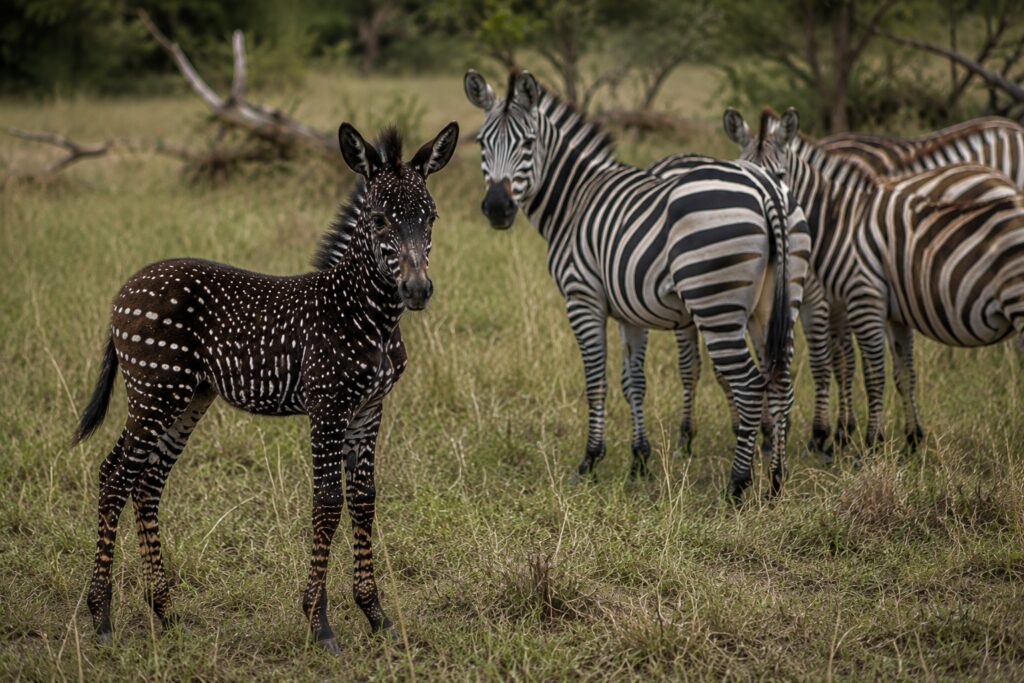
At first, even the guide who discovered Tira thought someone had painted him. That reaction makes sense because the young zebra looked completely different from the animals around him. Instead of the familiar black-and-white stripes, Tira had a mostly dark body covered in small, bright white spots.
When I first saw photographs of him, I understood why people found his appearance hard to believe. He looked almost like a fictional animal placed in the middle of a real zebra herd. Yet Tira was completely real, calmly living among normally striped zebras in Kenya’s famous Maasai Mara National Reserve.
Experts believe his unusual coat was caused by a rare genetic change that affected how his stripe pattern developed. Although Tira was not the first spotted zebra ever documented, he was the first recorded in the Maasai Mara. That made him one of the reserve’s rarest and most memorable wildlife sightings.
His story is fascinating not only because of the way he looked, but also because it reminds me how much variety can exist within nature.
The Discovery That Surprised an Experienced Guide
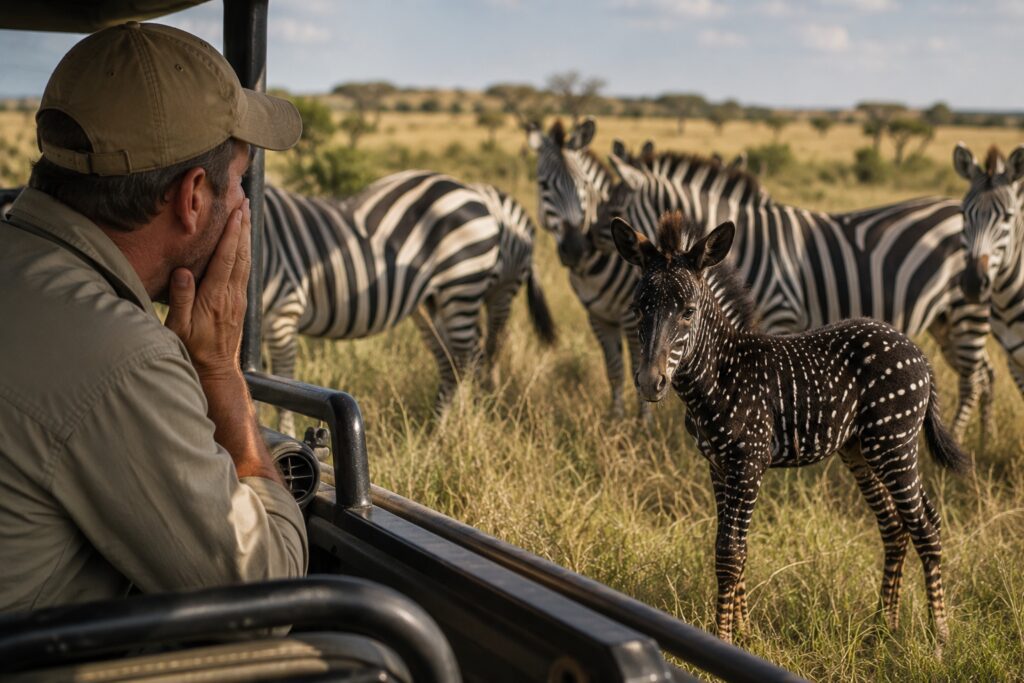
Wildlife guides in the Maasai Mara see incredible animals almost every day. They regularly encounter lions, elephants, cheetahs, giraffes, wildebeest, and large herds of zebras. It takes something truly unusual to surprise someone who spends so much time observing wildlife.
That is exactly what happened when Tira was first spotted.
At first, the guide reportedly struggled to believe the young animal was real. Tira’s dark coat and bright spots looked so unusual that he appeared to have been painted by a person. However, as the guide watched him moving naturally beside other zebras, it became clear that this was not a trick or an artificial marking.
Tira was a healthy-looking young zebra with a naturally unusual coat.
I think this part of the story explains why his discovery became so widely discussed. We are used to zebras having one of the most recognizable patterns in the animal kingdom. Their stripes are so familiar that seeing a zebra without them can feel almost impossible.
My personal tip when viewing unusual wildlife photographs online is to remain curious without immediately assuming the image is fake. Strange-looking animals do exist, but it is still wise to look for information from wildlife experts, researchers, or trusted conservation organizations before sharing a claim.
Why Tira Had Spots Instead of Normal Stripes?
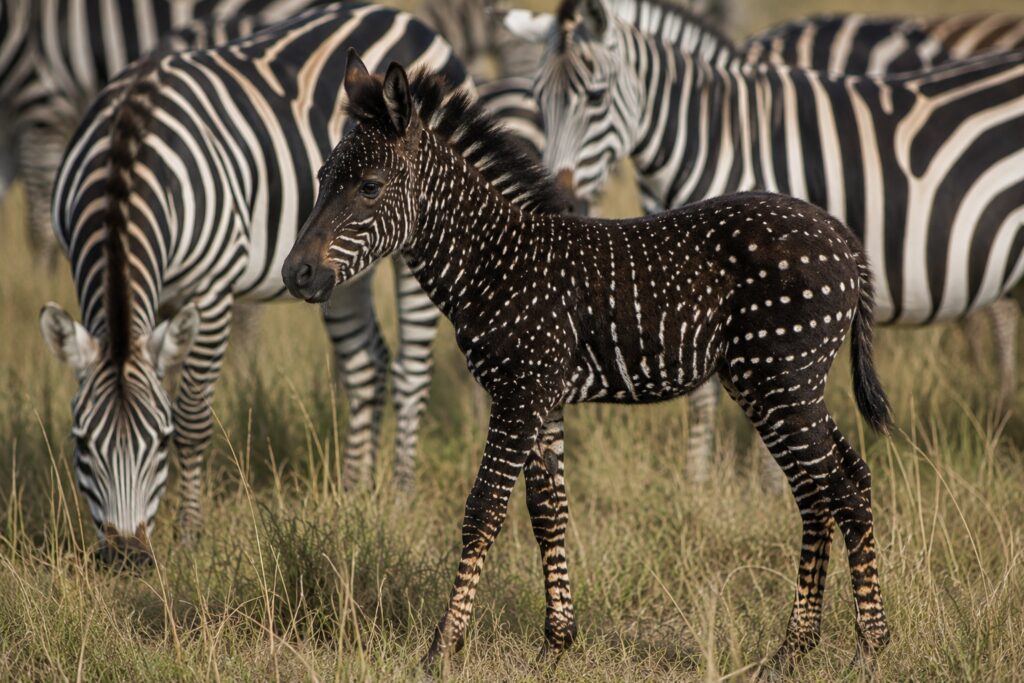
Tira’s coat was not a completely different color from that of other zebras. The main difference was the way his pigmentation appeared across his body. Instead of forming long white and black stripes, the lighter areas appeared as small spots against a dark background.
Experts believe this was connected to a rare genetic change affecting pigmentation and pattern formation.
Genes carry instructions that help guide the development of an animal’s body. These instructions influence many features, including size, eye color, fur color, and coat patterns. Sometimes, a genetic change alters the way certain cells produce or distribute pigment.
In Tira’s case, the change appears to have disrupted the usual stripe pattern. His body still produced both dark and light areas, but they were arranged differently.
I find this especially interesting because it shows that zebra stripes are not simply painted onto the animal after it develops. The pattern forms through a complicated biological process before birth. A small change in that process can produce a dramatic visual difference.
Some reports have connected unusual zebra patterns with conditions involving abnormal pigmentation. However, without detailed testing, it is safer to describe Tira’s appearance as a rare genetic pattern variation rather than make a highly specific diagnosis.
Tira Was Not the First Spotted Zebra in the World
Tira’s appearance was extremely rare, but he was not the first spotted zebra ever seen. Similar zebras had previously been documented in Botswana and other parts of Africa. This means the genetic variation was not completely unknown to wildlife experts.
What made Tira special was where he was found.
He was the first spotted zebra officially recorded in Kenya’s Maasai Mara. The reserve is one of the world’s best-known wildlife destinations, attracting researchers, photographers, filmmakers, and tourists from many countries.
Because so many people observe animals in the Maasai Mara, a zebra with such an unusual pattern quickly attracted attention. Tira became one of the reserve’s rarest sights and a powerful example of natural variation.
I think it is important to explain this carefully. Calling Tira the first spotted zebra in history would be inaccurate. Calling him the first recorded spotted zebra in the Maasai Mara is much more precise and still makes his discovery remarkable.
Whenever I write about rare animals, I try to separate “the first ever” from “the first recorded in a certain location.” That small detail can make an article much more trustworthy.
Could His Unusual Coat Affect His Survival?
Tira’s spots made him fascinating to people, but they may also have created challenges in the wild. Zebras usually live in groups, and their stripes may provide several possible benefits.
Scientists have studied whether stripes help confuse predators, reduce biting flies, control body temperature, or support recognition between zebras. Research continues, and not every question has a final answer. However, it is clear that the striped pattern is a normal and important part of zebra biology.
A spotted zebra may stand out more clearly from the herd, especially when the group is moving together. This could potentially make the animal easier for predators to notice. An unusual coat may also affect how other zebras respond to it, although Tira was seen living among normally striped animals.
Young zebras already face many dangers. Lions, hyenas, leopards, and other predators may target vulnerable foals. Drought, injury, disease, and limited food can also affect survival.
For that reason, wildlife experts were naturally interested in Tira’s future. His unusual appearance made him famous, but fame does not protect a wild animal from the realities of nature.
My personal advice for travelers is never to pressure guides to move too close to rare animals. Giving wildlife space reduces stress and allows natural behavior to continue without unnecessary interference.
Why Zebra Stripes Are So Unique?
Every zebra has its own stripe pattern, much like every human has unique fingerprints. Although zebras may look similar from a distance, their markings can help researchers and photographers identify individuals.
The three main zebra species also have different stripe patterns and body features. Plains zebras, which are commonly seen in the Maasai Mara, generally have broad stripes across much of the body. Grevy’s zebras tend to have narrower stripes, while mountain zebras have their own distinctive markings.
Tira’s spotted coat showed just how dramatically that normal pattern could change.
Interestingly, zebras are generally understood to have dark skin beneath their hair. Their coat pattern develops as pigment-producing cells create dark and light areas. Tira’s appearance seemed to emphasize the dark background while limiting the normal formation of long white stripes.
To me, this makes his coat even more interesting. He was not simply a white zebra covered in black dots. He appeared mostly dark, with pale markings scattered across his body.
That difference helped make him instantly recognizable.
Rare Animals Should Be Observed Responsibly
Whenever an unusual animal becomes famous, people naturally want to see it. Photographers, tourists, and social media users may all become interested. That attention can help raise awareness, but it can also create problems.
Too many vehicles can crowd an animal, block its movement, separate it from its herd, or cause stress. Young animals may be especially vulnerable because they depend heavily on their mothers and the protection of the group.
I believe rare wildlife should be admired with patience rather than chased for the perfect photograph. A responsible guide should maintain distance, avoid surrounding the animal, and follow the rules of the reserve.
People should also avoid sharing exact real-time locations of rare animals when doing so could attract large crowds or create a risk of harassment.
The best wildlife experience is not always the closest one. Sometimes, watching quietly from a respectful distance gives us a much more natural and meaningful view.
Tira Reminds Us That Nature Is Full of Surprises
Tira became famous because he looked unlike almost any zebra most people had ever seen. His dark body and bright white spots challenged our expectations and made even an experienced guide question what he was seeing.
Yet Tira was not a fantasy animal. He was a real zebra shaped by a rare variation in the biological process that normally creates stripes.
His discovery also reminds me why accurate storytelling matters. He was not the first spotted zebra in the world, but he was the first one recorded in the Maasai Mara. That still made him an extraordinary part of the reserve’s wildlife history.
Nature does not always follow the patterns we expect. Genetic changes can produce animals with unusual colors, markings, shapes, or features. Some variations may be harmless, while others can affect survival.
For me, Tira’s story is a reason to stay curious. Even in places that have been studied and photographed for decades, something completely unexpected can still appear among the herd.
He looked as though someone had painted him, but nature had created every spot.