It is easy to look at a multimillion-dollar offer and assume the decision should be simple. Sell the land, take the money, and begin a more comfortable life. But land can hold things that money cannot replace: childhood memories, family graves, familiar trees, working soil, and the feeling of knowing exactly where home is. That is why the story of Kentucky farmers Ida Huddleston and her daughter, Delsia Bare, has stayed with me.
Developers connected to an unidentified Fortune 100 company offered the family more than $26 million for farmland near Maysville, Kentucky. The property was being considered as part of a proposed data center development covering more than 2,000 acres in Mason County. Huddleston and Bare initially considered selling some of their land, but they soon reversed the decision and chose to stay.
Their refusal is now part of a much larger fight over artificial intelligence, electricity, water, rural development, and who gets to decide what happens to land that has supported families for generations.
A Farm That Carries More Than Financial Value
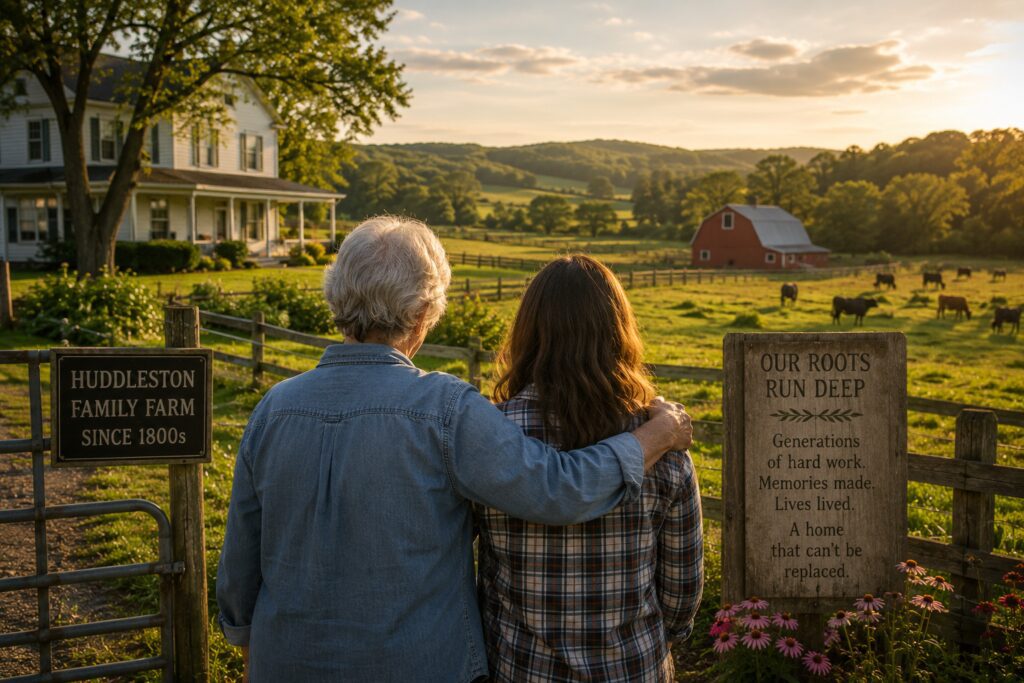
To understand their decision, I think we first have to stop viewing the farm as an ordinary real estate asset. It is not simply a collection of fields with a price per acre. It is a living family history that has been built slowly over more than two centuries.
Huddleston has lived on the property since she was a teenager. Bare remembers riding horses along its fences as a child. Their relatives raised animals, grew crops, built homes, and buried loved ones on the land.
The family reportedly owns around 1,200 acres in the area, although the widely reported $26 million offer involved specific parcels owned by Huddleston and Bare rather than the entire farm. Huddleston was offered approximately $60,000 per acre for 71 acres, while Bare was offered about $48,000 per acre for 463 acres. Those numbers are enormous. However, financial value and personal value are not always the same thing.
I think many people understand this instinctively. A family photograph may have almost no market value, yet losing it can feel devastating. Land can carry that same emotional weight, multiplied across generations.
For Huddleston, leaving would have meant more than moving to a different house. It would have meant leaving her flower beds, her routines, her community, and the landscape that had shaped most of her life.
Why AI Companies Need So Much Land?
Artificial intelligence often feels invisible. We type a question into a phone or computer, and an answer appears within seconds. But every AI request depends on physical infrastructure somewhere in the world.
Data centers are enormous buildings filled with computer servers. Those servers process, store, and move digital information. Advanced AI systems require particularly powerful computing equipment, which can consume large amounts of electricity and produce considerable heat.
The proposed Mason County campus has been described as a hyperscale data center development. County officials approved rezoning for 28 properties covering approximately 2,080 acres outside Maysville in May 2026. Plans described multiple data center buildings, substations, cooling equipment, water tanks, roads, stormwater systems, and other supporting infrastructure.
This is something I believe people need to understand more clearly: the “cloud” is not floating above us. It is built on land. It requires buildings, electricity lines, cooling systems, roads, water access, backup generators, and physical connections to communications networks. As demand for AI increases, companies are searching for places where these facilities can be built quickly and operated at a massive scale.
Rural areas can appear attractive because they often have large connected parcels, lower land prices, fewer buildings, and less restrictive development rules than major cities. But what looks like empty space on a developer’s map may actually be someone’s home, livelihood, food-producing land, or family history.
The Project’s Enormous Energy Needs
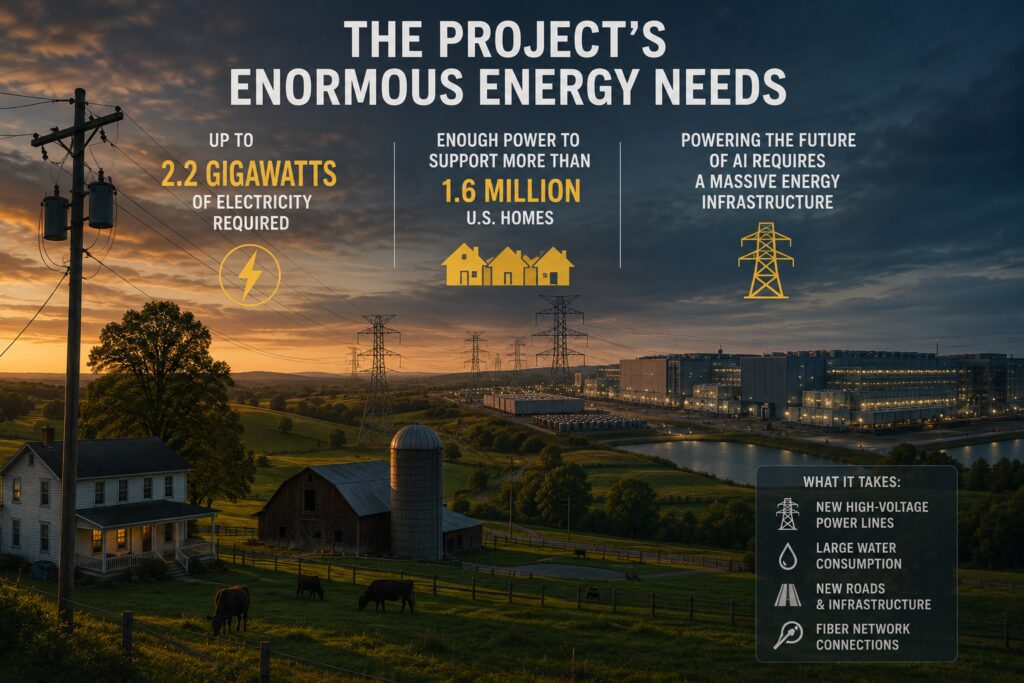
The scale of the proposed electricity demand is one of the main reasons residents are concerned. Reports connected to the Mason County project have cited a possible data center load of up to 2.2 gigawatts. A gigawatt is one billion watts. A 2.2-gigawatt demand would therefore represent a very large industrial electricity load, although actual consumption would depend on how much of the campus was eventually constructed and operated.
The developer’s representatives have reportedly said the unidentified company would pay for the necessary infrastructure upgrades. Supporters also point to potential construction jobs, permanent employment, and new tax revenue for the county. Earlier project discussions suggested the development could create about 1,500 construction jobs and approximately 400 permanent positions. Some residents and farmers remain skeptical about how many long-term local jobs would actually be created once construction ended.
I do not think promised benefits should be dismissed automatically. Rural communities need employment, public revenue, infrastructure, and economic opportunity. However, promises should be supported by binding agreements and transparent information.
Before approving a development of this size, residents deserve clear answers about electricity demand, water use, utility costs, noise, backup generators, tax arrangements, emergency planning, and the number of permanent jobs. My practical advice for any community facing a similar proposal is to ask for specific numbers rather than broad promises. “Jobs” is not enough. Communities should ask how many jobs, what type, how much they pay, how long they last, and whether local residents will qualify for them.
Water Is More Than a Technical Detail
Electricity may receive the most attention, but water can be just as important. Data centers produce heat, and many facilities use water-based systems to help cool their equipment. The amount of water required varies widely. It depends on the cooling technology, local climate, facility design, operating schedule, and whether recycled or drinking-quality water is used.
Opponents of the Mason County project fear that a development of this scale could place pressure on local water and sewer systems. They also worry that new industrial demand could compete with homes, farms, and future community needs. I believe water questions should never be treated as minor technical details.
Farmers depend on predictable water supplies. Households need affordable drinking water. Rivers, wetlands, and groundwater also support wildlife and local ecosystems. A responsible review should therefore explain where the facility’s water would come from, how much it could use during peak periods, how wastewater would be handled, and what would happen during droughts.
It is not enough to say infrastructure will be upgraded. Residents need to know whether the new system will protect them or mainly serve the new development.
When Farmland Becomes Industrial Land?
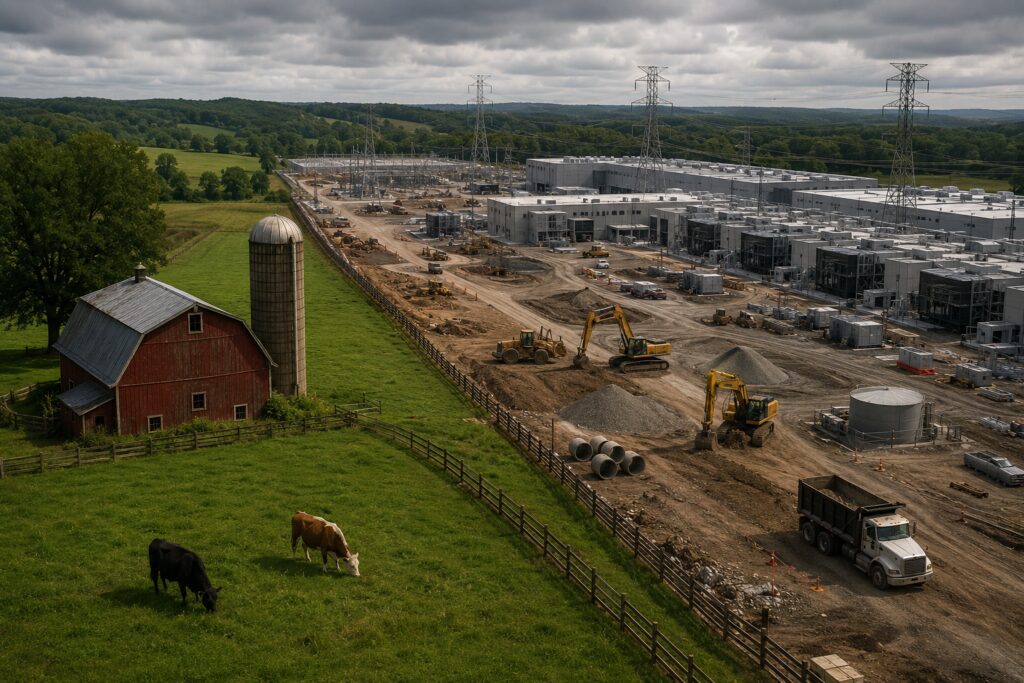
Farmland may look open and available, but its value extends far beyond its sale price. It produces food, absorbs rainwater, stores carbon in soil, provides wildlife habitat, and supports rural businesses and families.
Once productive farmland is covered with large buildings, roads, substations, and parking areas, returning it to agriculture may be extremely difficult. That does not mean farmland should never be developed. Communities have always changed, and new infrastructure has to be built somewhere. But I think we should be much more careful about which land is sacrificed.
Before converting large areas of productive farmland, developers and officials should seriously consider brownfields, abandoned industrial areas, former mines, underused commercial land, and locations already served by major infrastructure. These alternatives may be more complicated or expensive. Yet the cheapest site for a company is not always the best site for a community.
Huddleston captured this concern in simple language when she said that no one is making more land. Her point goes beyond property ownership. Once fertile soil and rural landscapes are permanently transformed, a community may never recover what it lost.
The Emotional Pressure Behind a Huge Offer
One of the most revealing parts of this story is that Huddleston and Bare did not immediately reject every discussion. They briefly agreed to sell before realizing that the decision felt unbearable. Bare later sought legal advice and learned that the developers could not simply force the family to surrender the property under the circumstances described.
That detail matters because people sometimes assume a signed offer means a landowner was fully comfortable with the project. In reality, families facing powerful developers may feel confused, isolated, or afraid that refusing will leave them surrounded by industrial development anyway.
Offers far above normal farmland value can also create tension between neighbors and relatives. One family may see a chance for financial security, while another may see the destruction of a shared rural landscape. I do not judge people who choose to sell. Farming is financially difficult, and a life-changing offer may help someone retire, pay debts, support children, or escape years of uncertainty.
But people who choose not to sell deserve respect too. The important issue is whether landowners receive accurate information, independent legal advice, enough time to decide, and freedom from misleading pressure.
My personal tip is simple: anyone approached with a major land agreement should consult an independent property lawyer before signing. The developer’s agent represents the buyer’s interests, not the landowner’s.
A Community Already Experiencing Displacement
The conflict is not limited to one family farm. Residents have organized through the group We Are Mason County to oppose or challenge parts of the proposed development.
The group has argued that county zoning decisions conflict with existing planning rules and that officials moved forward without enough transparency about the developer and the full effects of the project. An initial legal challenge was dismissed, but opponents continued pursuing legal action as the zoning and development process advanced. The human consequences are already visible for some nearby residents. According to the account provided in the source article, people living in a mobile-home community received 90-day eviction notices after property connected to the development was acquired.
This part of the story troubles me deeply. Large projects are often presented through numbers: acres developed, dollars invested, megawatts consumed, and jobs created. But those numbers can hide individual households that must move, elderly residents who lose familiar neighbors, and families who struggle to find affordable housing nearby.
Economic development should not require treating existing residents as obstacles. At a minimum, displaced people should receive meaningful relocation support, adequate notice, fair compensation, and help finding comparable housing.
The Secrecy Makes Trust More Difficult
Another major concern is that the Fortune 100 company behind the proposed campus has not been publicly identified in much of the reporting. Confidentiality is common during commercial negotiations. Companies may argue that secrecy protects competitive information before a final deal is completed.
However, the larger and more resource-intensive a project becomes, the harder that secrecy is to justify. A project demanding vast amounts of land, electricity, water, road access, and public planning decisions will reshape the surrounding community. Residents should know who is asking them to accept those changes.
I believe transparency should increase with impact. A small private business may reasonably keep some negotiations confidential. A multibillion-dollar development capable of changing utility systems and land use across an entire county should face much stronger public disclosure requirements. Communities cannot give meaningful consent when essential information is hidden.
This Is Not Simply a Fight Against Technology
It would be easy to frame Huddleston and Bare as people resisting progress. I do not see it that way. AI can support scientific research, healthcare, education, accessibility, disaster forecasting, and many other useful applications. Data centers are necessary for the digital services that modern society increasingly depends on. The question is not whether technology should exist.
The question is how its physical costs should be shared and who should carry them. Should rural families lose homes so distant consumers can access faster digital tools? Should local utility customers face possible pressure on electricity or water systems? Should productive agricultural land be converted before previously developed sites are fully considered?
These are not anti-technology questions. They are responsible planning questions. Technology should serve people without making certain communities invisible.
What This Family’s Stand Teaches Me?
The decision to refuse $26 million is extraordinary, but the deeper lesson is not that everyone should make the same choice. The lesson is that value cannot always be measured in dollars.
For Huddleston and Bare, the farm provides food, memory, identity, independence, and continuity. Selling it might have made them wealthy, but it would also have ended something their family had protected for more than 200 years. Their story encourages me to look more carefully at the physical footprint behind artificial intelligence. Every digital convenience begins somewhere—with land, minerals, power plants, transmission lines, water systems, workers, and communities.
As AI continues expanding, I believe we need clearer national and local standards for where data centers are built. Communities need independent environmental reviews, realistic resource plans, transparent tax agreements, and genuine public participation before rezoning is approved. Developers should also be encouraged to use cleaner energy, water-efficient cooling, previously disturbed land, and designs that reduce noise and environmental damage. Most importantly, people who live near proposed sites should be involved before decisions become nearly impossible to reverse.
Some Things Cannot Be Rebuilt
The Mason County project is still moving through legal, political, and development processes. Rezoning has been approved, opponents continue challenging the plan, and the identity of the company behind it remains a major concern for residents. No one yet knows exactly what the final landscape will look like.
But Huddleston and Bare have made their position clear. They intend to remain on their farm. I find their decision powerful because it challenges a belief that almost everything has a price. Money can purchase another house, but it cannot recreate 200 years of family history. It can buy different soil, but it cannot reproduce the exact fields where generations worked, played, grieved, and grew old.
The AI boom is often described as a race toward the future. Yet progress should not require forgetting what already matters. A responsible future must make room for technology, but it must also protect water, food-producing land, rural communities, and the right of families to say no. Huddleston and Bare are not simply defending a farm. They are reminding us that once some things are destroyed, no amount of money or computing power can bring them back.