Indigenous clam gardens show that sustainable marine innovation is far from new. Long before modern engineering, Indigenous Nations along the Pacific Northwest Coast reshaped shorelines to increase shellfish harvests, support biodiversity, and care for coastal ecosystems.
I find their knowledge remarkable because these ancient systems still offer valuable lessons about food security, climate resilience, and working with nature rather than against it.
What Is an Indigenous Clam Garden?
At first glance, a clam garden may look like an ordinary rocky beach. However, beneath the surface is a carefully engineered coastal system designed to create better growing conditions for shellfish.
These gardens show how closely Indigenous communities observed tides, sediments, animal behavior, and seasonal changes.
Beginning at least 3,800 years ago, coastal Nations including the Coast Salish, Kwakwaka’wakw, Haida, Heiltsuk, and Kitasoo/Xai’xais constructed rock walls near the lowest tide line.
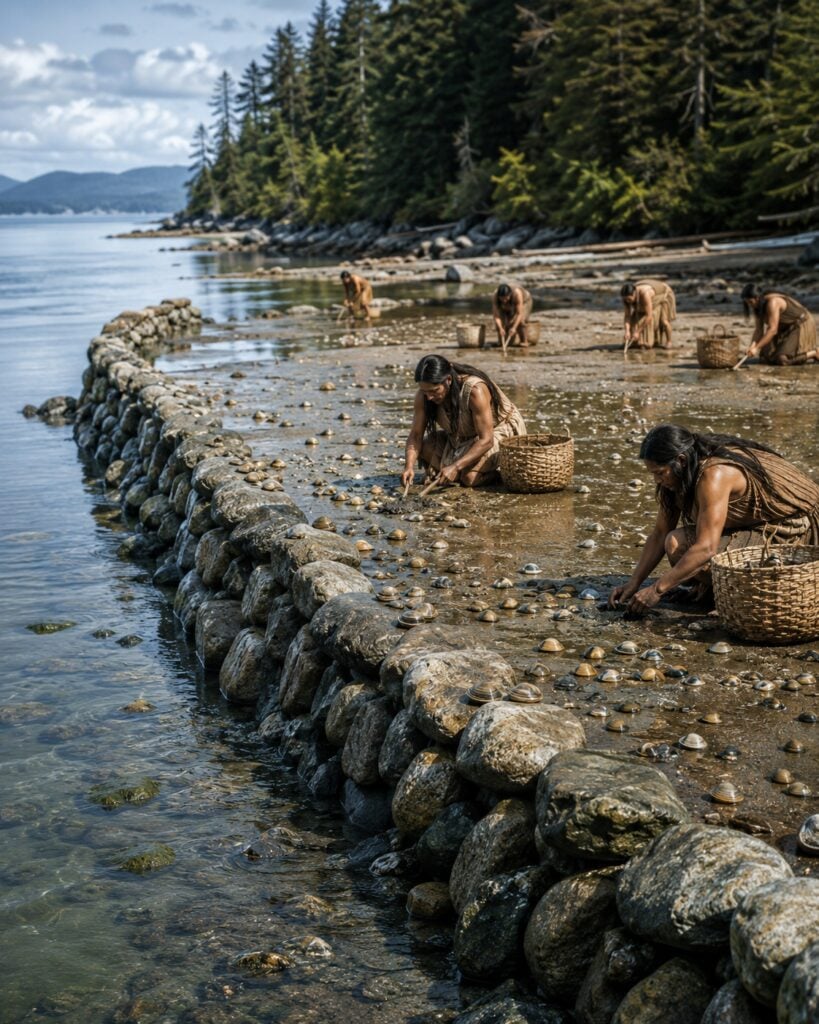
As tides moved in and out, the walls gradually trapped sand, broken shells, and sediment.
This process transformed steep or rocky beaches into wide, gently sloping terraces. The new terraces created shallow, oxygen-rich areas where clams could feed, grow, and reproduce more successfully.
Important species included butter clams, littleneck clams, and horse clams, all of which supported local diets, trade, ceremonies, and community life.
What impresses me most is that these systems were built without modern machinery.
They required careful planning, strong community cooperation, and knowledge passed down over many generations.
How Clam Gardens Increased Food Production?
Clam gardens were not only culturally important. They were also highly productive food systems. By changing the shape and condition of the shoreline, Indigenous communities created habitat where larger numbers of shellfish could survive.
Research has found that managed clam gardens can produce significantly more shellfish than natural, unmanaged beaches.
Clams may also grow faster in these environments because the terraces offer better water flow, food access, and sediment conditions.
This was especially important for coastal communities that depended on reliable local food sources. Shellfish could be harvested during different seasons, preserved, shared, and used during times when other foods were less available.
I see clam gardens as an early form of sustainable aquaculture.
Unlike industrial food systems that may depend on chemicals, artificial feed, or heavy equipment, clam gardens improved natural habitat instead of replacing it.
A useful lesson for modern food production is that increasing harvests does not always require damaging an ecosystem.
Sometimes productivity improves when the habitat itself becomes healthier.
These Gardens Supported More Than Clams
One of the most important things about clam gardens is that their benefits extended far beyond shellfish. By improving the structure of the shoreline, these terraces created habitat for many other marine organisms.
Clam gardens can support eelgrass, small fish, crabs, birds, and other species that depend on healthy coastal environments.
Eelgrass beds are especially valuable because they act as nurseries for marine life, help trap sediment, and reduce the impact of waves.

These habitats may also help protect shorelines from erosion. As climate change increases sea levels and strengthens coastal storms, healthy eelgrass beds and well-managed shorelines may provide a natural form of protection.
I believe this is one of the strongest lessons clam gardens offer.
A well-designed environmental system can solve several problems at once. It can provide food, strengthen biodiversity, preserve cultural practices, and support climate resilience.
Modern projects often focus on one goal at a time. Indigenous stewardship shows us the value of thinking about the entire ecosystem instead.
Indigenous Stewardship Required Constant Care
Building the rock walls was only the beginning. Clam gardens remained productive because communities regularly cared for them. This long-term maintenance was essential to keeping the sediments healthy and the shellfish population strong.
People loosened and aerated the beach sediment so oxygen and water could move through it.
They removed large rocks that blocked growing areas and returned crushed shells to the shoreline to improve the beach structure.
Communities also managed predators and harvested clams carefully. These practices prevented the ecosystem from becoming unbalanced while allowing shellfish populations to recover and continue reproducing.
This reminds me that sustainability is not something people achieve once and then forget. It is an ongoing relationship that requires observation, adjustment, and responsibility.
My personal tip for understanding traditional stewardship is to avoid viewing it as a collection of isolated techniques.
It is better understood as a complete system involving food, culture, family roles, seasonal knowledge, and respect for future generations.
Traditional Knowledge and Modern Science Are Working Together
Today, clam garden restoration is bringing Indigenous knowledge holders, community members, archaeologists, marine biologists, and conservation groups together.
These collaborations help researchers understand how ancient gardens worked while supporting Indigenous leadership over coastal lands and waters.
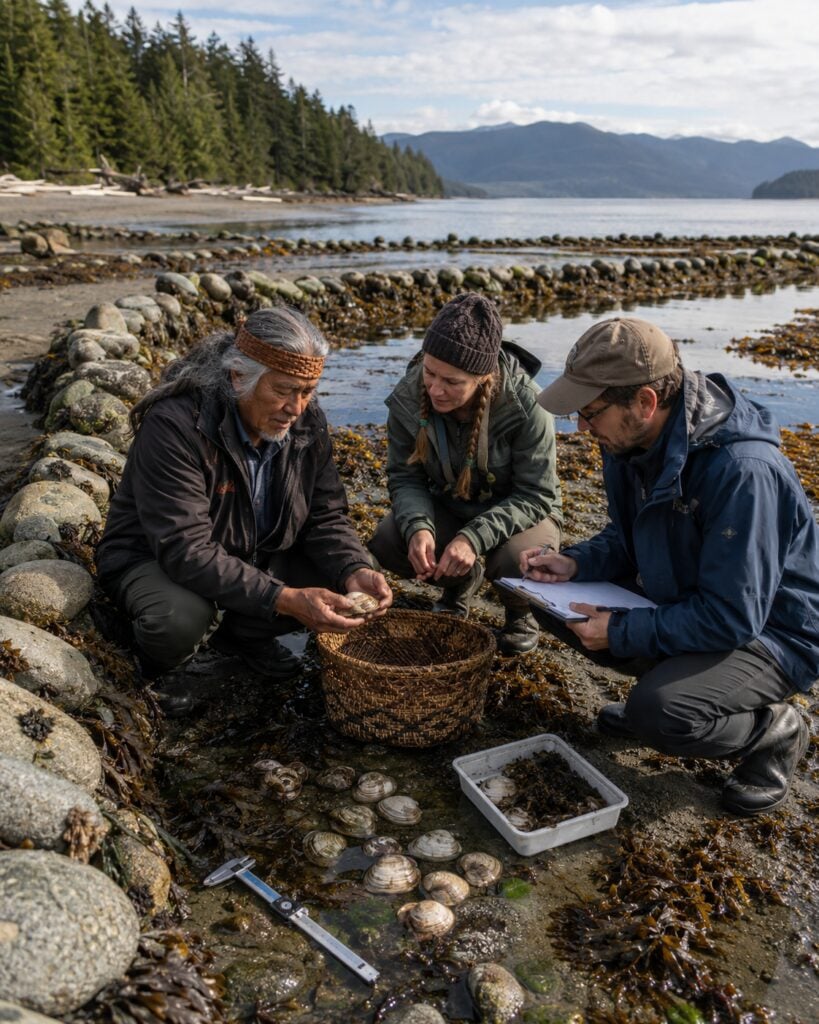
Initiatives such as the Clam Garden Network connect communities and researchers involved in documenting, restoring, and maintaining clam gardens across the Pacific Northwest.
This work is not simply about rebuilding old stone walls. It supports food sovereignty by helping communities regain greater control over traditional food systems.
It also creates opportunities for elders to share knowledge with younger generations.
Language revitalization can also be part of the process. Traditional names, harvesting practices, stories, and environmental knowledge are often closely connected.
Restoring a food system may therefore help strengthen cultural identity as well.
I think scientific partnerships are most valuable when Indigenous knowledge is treated as a living system of expertise, not simply as historical information for researchers to collect.
Clam Gardens Can Strengthen Climate Resilience
Climate change is creating serious challenges for coastal communities. Rising seas, warmer water, ocean acidification, erosion, and changing species patterns are affecting both ecosystems and food security.
Clam gardens cannot solve every environmental problem, but they may help shorelines become more resilient. Their rock walls can reduce erosion, while healthy sediments and eelgrass beds support a wider range of marine species.
Restored gardens may also create local food sources that are less dependent on long transportation networks. This can be especially valuable for remote coastal communities where imported food is expensive or difficult to access.
For me, climate resilience does not only mean building larger walls or inventing more advanced technology.
It also means protecting knowledge that has already helped communities survive environmental change for thousands of years.
A practical lesson is to study local solutions before introducing outside systems.
The people who have lived in an environment for generations may already understand patterns that short-term research has only started to recognize.
Why These Ancient Systems Still Matter?
Clam gardens remind us that Indigenous communities have long been scientists, engineers, food producers, and environmental managers. Their innovations were based on detailed observation and a responsibility to care for both present and future generations.
For too long, Indigenous knowledge has sometimes been treated as folklore rather than a serious source of environmental understanding.
Clam garden research shows why that view is incomplete and unfair.
These coastal systems increased food production without destroying the habitat that supported it. They strengthened biodiversity while helping communities remain connected to culture, language, and place.
I believe their greatest lesson is simple.
Humans do not always have to choose between using an ecosystem and protecting it. With knowledge, restraint, and long-term care, both goals can support each other.
Ancient Indigenous clam gardens are not just archaeological remains. They are living examples of sustainable design and a reminder that some of the world’s most effective environmental solutions have existed for thousands of years.
Traditional knowledge still has much to teach us. The question is whether we are willing to listen with the respect it deserves.